

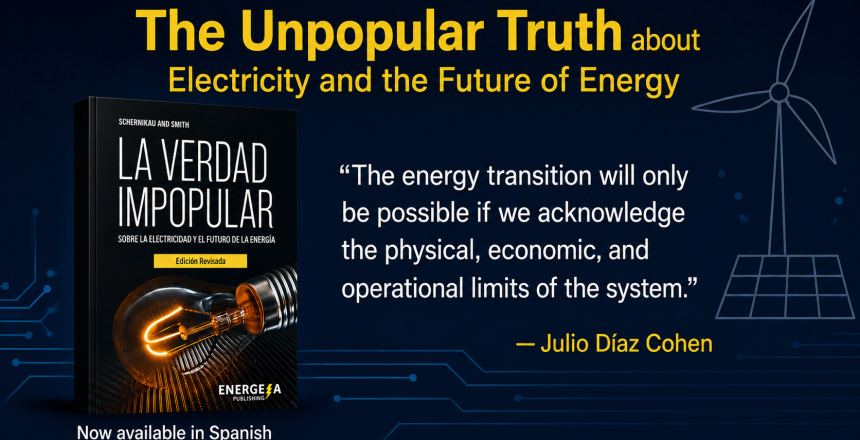
I am pleased to share with you the Spanish release of a book that I had the honor of collaborating on its revision and adaptation, and which is now available on Amazon .
📕 “The Unpopular Truth About Electricity and the Future of Energy” , by Dr. Lars Schernikau and Prof. William Hayden Smith.
For years, we’ve talked about the energy transition as if it were a linear path. But the reality is much more complex. It’s not enough to simply install more solar panels or wind turbines. To build a truly sustainable electricity system, we must recognize and address the physical, economic, and operational limitations that accompany this transformation.
With this new Spanish edition, the book is now available in seven languages: English, German, Vietnamese, Indonesian, Korean, Polish, and Spanish. A clear sign of its growing reach and global impact.
This work represents a valuable contribution to the current global energy debate. It offers a critical, rigorous, and well-documented look at the technical foundations that are often omitted from public discussions about the energy transition. It is a book that does not shy away from asking uncomfortable questions or challenging the most widespread narratives about the energy future.
Collaborating on this revised edition was, for me, an exercise in reflection and learning. As a professional in the sector, it challenged me to review assumptions, analyze data more rigorously, and reaffirm the importance of moving towards a sustainable and responsible energy transition.
If, like me, you have always been interested in understanding the whys and wherefores of things and seek to understand the structural challenges of the energy transition beyond the headlines, this book is for you.
I invite you to read the full prologue that I had the honor of writing for this edition. I hope it serves as a starting point for discovering a book that encourages questioning, reflection, and well-founded debate.

Foreword by Julio Diaz Cohen
Energy is the silent engine of our civilization. It’s in everything we do: how we get around, how we eat, how we communicate, and ultimately, how we thrive as a society. Yet we rarely stop to consider what it takes to produce, distribute, and sustain it over time.
From my more than 25 years of experience in the energy industry, I have observed the challenges associated with ensuring a reliable, affordable, and sustainable energy supply. Energy is not merely a technical matter; it is fundamental to the development of societies and global economic stability. The book, The Unpopular Truth About Electricity and the Future of Energy , presents an in-depth and realistic analysis of a complex topic that is often oversimplified in public debate. Today, the energy transition and the fight against climate change dominate the global agenda. We know that reducing emissions is essential, but the question we should be asking ourselves is not only what we must do, but also how to do it without creating new problems along the way.
Just a few decades ago, the scientific community couldn’t reach a consensus on climate change. Today, its existence and impact are undeniable. But what if we were facing a similar dilemma with the goal of achieving net-zero emissions? We have embarked on this transition with admirable determination, but without yet having all the necessary tools and certainties to ensure that this path doesn’t lead us to an even greater problem.
The best intentions can lead us down uncertain paths if they are not properly analyzed and substantiated. It is easy to embrace solutions that seem correct on the surface, without considering their long-term implications. That is why we need a more balanced vision, one that integrates the urgency of action with the reality of the technological, physical, and economic limitations of our energy options and their complexities.
This book, written by Dr. Lars Schernikau and Prof. William Hayden Smith, offers precisely that: a holistic, grounded, and data-driven perspective on energy and its future. Throughout its pages, the authors debunk myths, present the complexities of the energy system, and invite us to think beyond what we typically hear in official discourse and the media. It is not a work of opposition or denial; it is a call to reflection, critical analysis, and the search for solutions that truly work.
There is no single answer or path to a sustainable energy future. But if we want to achieve it without sacrificing stability, well-being, and development, we must begin by understanding energy in its entirety. I hope this book helps foster that understanding and inspires a more informed and constructive dialogue.
Congratulations to the authors for their outstanding work, and my deepest gratitude for their trust and the invitation to share this work with the Spanish-speaking community. It has been an honor to be part of this project and to help bring this knowledge to a wider audience.