

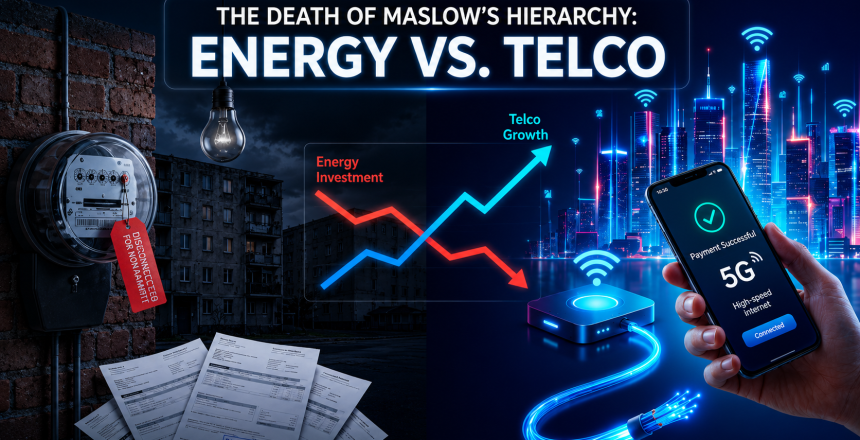
In many cities across Latin America and the world today, something is happening that would have seemed unthinkable just a decade ago: homes can lose electricity, but not their digital connection . The refrigerator shuts off, the lights go out, but the smartphone stays on. By 2026, this is no longer an isolated anecdote, but rather a reflection of a new social hierarchy of priorities: Wi-Fi has displaced electricity in the pyramid of basic needs .
While electricity distributors face delinquency levels that severely limit their investment capacity, telecommunications companies exhibit remarkably faster collections . The question is as uncomfortable as it is revealing: why is a citizen in Latin America willing to risk their home’s cold chain rather than lose their mobile connection or internet access?
This gap is not just an operational or commercial problem. It’s a structural obstacle to the energy transition . If we don’t understand why users prioritize a $50 data bill over a $50 electricity bill , we’ll hardly be able to finance the smart, resilient, and digitized grids that the economy of the future demands.
This article analyzes how the immediacy of digital punishment , the perception of value , and the architecture of collection are redefining delinquency in public services on a global scale, and why the electricity sector needs to rethink its model if it does not want to fall behind in the new electrified economy.
The Anatomy of Spending: How much does it cost to be “connected” vs. “enlightened”?
To understand the decline of the electricity sector, we must first look at the numbers. By 2026, the basic basket of services has changed radically. While electricity continues to be seen as an invisible commodity , access to data is perceived as digital oxygen.

When the analysis is scaled down to the family unit, the reality is undeniable: in a household with three or four mobile devices, the total cost of telecommunications typically exceeds the electricity bill. However, this sector maintains minimal delinquency rates. This suggests something crucial: the problem lies not in the ability to pay, but in a shift in the user’s priorities , in which the electricity industry has been defeated.
Why does this gap occur? The four pillars of the electrical “defeat”
The disparity in revenue collection is not accidental. It stems from a service architecture that telecommunications companies have perfected and that the energy sector is still struggling to implement.
1. The Vulnerability of the Electrical Grid and the Asymmetry of Punishment
In telecommunications, service disconnection is surgical, automated, and has zero marginal cost . If the system doesn’t register payment at the scheduled disconnection time, the digital “switch” suspends service instantly. There’s no negotiation, no geographical barriers, and, most importantly, no operational friction. Telecommunications networks are digitally secure.
Conversely, in the electricity sector, suspending supply remains physical, bureaucratic, and costly:
- The asymmetry of service disconnection: In telecommunications, temporary service interruptions typically occur just 15 to 30 days after non-payment. Notification is digital (SMS or email), and the suspension is automatic. After three months of non-payment, in many jurisdictions, the disconnection is final, and the user even loses their phone number. In the electricity sector, legal deadlines are usually longer. Generally, at least two billing cycles must have passed , and a certified physical notification must be sent before any action can be taken. Furthermore, some jurisdictions have restrictions on the days service can be disconnected (service cannot be cut off on Fridays, the eve of public holidays, or weekends) to prevent leaving customers completely without service.
- The “crew” factor: Disconnection requires a work order, a vehicle in the field, and technical personnel. This deployment has an operating and maintenance (O&M) cost that often discourages disconnection for minor debts, sending the wrong message of permissiveness to the market.
- The barrier to entry for reconnection: While in the telecommunications sector the service is 100% transactional—you pay digitally and the algorithm restores your signal in minutes—the “penalty” is brief if you have the money. In the electricity sector, disconnection and reconnection involve a physical act. The law requires the company to have crews available, but the permitted response times are lengthy (up to 24-48 hours). Ironically, this operational slowness makes the fairness of the system seem “bureaucratic,” diminishing the urgency of timely payment compared to the immediacy of telecommunications.
- The exposed network vs. the encrypted network: It’s physically easy to tap into a low-voltage power line with a copper wire, but it’s technically complex and pointless to try to bypass a fiber optic cable or a 5G cell to obtain free service. Electrical infrastructure is exposed to the environment and physically vulnerable; telecommunications infrastructure is protected by authentication protocols and software.
While in telecommunications “signal theft” has been virtually eradicated through data encryption and device authentication, in the electricity sector we face a persistent physical reality. Non-technical losses (NTLs) —a technical euphemism for energy theft—represent the most extreme form of non-payment.
Telcos manage billing with codes; electric utilities, with logistics. In a digital world, the algorithm almost always wins the cash flow race.
2. The Legal Framework: Universal Service vs. Private Contract
In Latin America and Europe, electricity is seen as a universal and fundamental human right , which has led to regulatory frameworks that heavily protect the user . While this is socially responsible, in practice it has fostered a “pay later” culture, something that telecommunications companies—perceived as private value-added services —do not have to manage.
In the electricity sector, there are Energy Poverty laws and Critical Customer categories . If a residence houses people with medical equipment (electrical-dependent individuals) or families at risk of social exclusion, there are laws that strictly prohibit service disconnection , regardless of the debt. This creates a buffer against non-payment that the user is aware of… and utilizes. In Telecommunications, except for exceptional measures (as occurred during the 2020 pandemic), there is no such thing as a “digitally vulnerable” user . If there is no payment, there is disconnection. It doesn’t matter if the user uses the internet for education or work; the law allows the company to suspend the data flow immediately.
In the telecommunications sector, internet and mobile phone access is not recognized as a universal right in the same way as access to clean water or electricity. Although the concept of Universal Service exists, it is usually limited to a basic level of connectivity. As a result, operators have broad contractual freedom to suspend service after the first instance of non-compliance by the user.
In contrast, in the electricity sector, most legislation—such as Law 6 of 1997 in Panama or European Union directives—considers electricity an essential public service. This imposes on the State and electricity distribution companies the obligation to guarantee continuity of supply, making service interruption processes significantly more rigorous, regulated, and time-consuming.
The certainty and speed of punishment in Telcos disciplines the user to pay on time or lose the service immediately, unlike energy where many rely (sometimes correctly) on delays, extensions or indulgences before being left in the dark.
In short: Telcos manage billing with codes; electric utilities manage it with logistics. In a digital world, the algorithm always wins the cash flow race.
3. Barriers to Entry and Alternatives
Switching providers or finding alternatives is much easier in telephony than in electricity.
The mobile market is highly competitive : if a company cuts service or raises prices, the user can buy another SIM card (even without paperwork, at a kiosk) and have a new line in minutes. Customer loyalty is low, and the Telcos know it; that’s why they offer discounts, financed devices, and attractive plans to retain customers, but if someone can’t pay, they simply don’t top up or port their number to another operator.
In contrast, electricity distribution is a natural monopoly: a single company per area, with no immediate substitute. This lack of options weakens the incentive to “pay to avoid losing service,” especially when “unfair competition” arises in informal contexts: electricity theft .
If the power is cut off for non-payment, many users illegally reconnect or create “jumpers,” a crime widely tolerated in certain areas (though dangerous). This kind of alternative escape route has no parallel in telecommunications—you can’t “piggyback” on a cell phone service without authentication. As the saying goes, nobody steals their neighbor’s Wi-Fi indefinitely or hacks their cell phone signal because it’s technically complex and easy to block; in contrast, stealing electricity from the power lines is feasible and common in many communities.
In short, the ease of switching to or circumventing the provider tips the scales – the user pays first when there’s no way out. With telephone or internet, it’s pay or be cut off; electricity, in permissive environments, offers loopholes (from political subsidies to piracy) that undermine the urgency of payment.
4. The Smartphone as a Production Tool
The smartphone has become a productivity and income tool, especially in the era of the gig economy . For millions of people, the phone and internet access are their means of work: Uber drivers, food delivery workers, digital freelancers—all depend on being connected to generate income. Even outside the gig economy, mobile phones are used to search for jobs, conduct banking transactions, or coordinate business.
In contrast, electricity , while even more essential, operates more as an invisible service already taken for granted – it provides comfort (lighting, cooling) and supports modern life, but is not directly associated with immediate income generation for most. Thus, faced with economic constraints, paying for things that impact daily productivity becomes psychologically more urgent .
A person can continue working on their phone even if they’re living by candlelight for a few nights at home. Furthermore, the smartphone provides an immediate perceived benefit: it’s a screen, communication, access to social networks – elements that offer constant gratification.
Electricity, being more abstract (until it’s lacking), is underestimated. Studies show that nearly 46 million Latin Americans already participate in the digital platform economy; for them, running out of mobile data means losing income that day , whereas a power outage could be managed temporarily (by going to well-lit areas, using batteries, etc.). In short, paying for your phone is associated with maintaining productive and social life, while paying for electricity is perceived as maintaining a household comfort —important, yes, but not a priority if a choice has to be made.
In short, paying for phone or internet is associated with productive and social life ; paying for electricity, with domestic comfort , vital but postponable when the budget is tight.
The Real Wall: Politics, Perception, and the Real Economics of Energy
Up to this point, the analysis has explored processes, incentives, and regulatory frameworks. But explaining the gap between electricity and telecommunications solely from a technical perspective would be insufficient. The most decisive obstacle—and the most difficult to address—lies not in the systems or the technology, but in the politics and culture surrounding the electricity service.
The modernization of the electricity sector clashes with two powerful narratives that have shaped the social perception of energy for years and that today act as silent brakes on investment, revenue collection and, ultimately, the energy transition.
1. Tariff Populism: When Electricity Becomes an Election Promise
In much of Latin America—and in other regions as well—electricity has been used as a short-term policy tool. Freezing rates, postponing adjustments, or expanding widespread subsidies is often politically advantageous but economically corrosive.
The effect is perverse: what is artificially “saved” on the bill today is paid for tomorrow —and then some— in the form of obsolete networks, recurring blackouts, less climate resilience and an energy transition that never quite materializes.
This approach distorts the incentives of the entire system. The user internalizes a clear message: electricity is cheap, negotiable, and politically protected . And when the service is perceived this way, the urgency of payment disappears. Late payments cease to be an anomaly and become part of the informal equilibrium of the system.
Telecommunications, however, operate outside of that implicit agreement. They are not campaign promises; they are contracts. And contracts are either honored… or terminated.
2. The Myth of Self-Reliance: From “Free Sun” to Valueless Energy
Adding to this problem is a deeply ingrained idea: if natural resources are “ours”—sun, wind, water—then energy should be free or nearly free. The narrative is intuitive, but incomplete.
The sun is free. The wind is free. Water is free.
What is not free is the system that converts those resources into reliable, continuous and safe electricity: transmission and distribution networks, substations, protection systems, digitization, backup and resilience to extreme weather events.
When this economic reality is not clearly communicated, the link between perceived value and real cost breaks down . Electricity ceases to be understood as a complex service requiring ongoing investment and comes to be seen as an unlimited right, disconnected from its financial sustainability.
The Impact: A brake on the Energy Transition and Resilience
This is where the problem ceases to be purely accounting-related and becomes strategic. A distributor with a 15% delinquency rate or high non-technical losses does not have the necessary cash flow to invest in:
- Smart Grids: Crucial for detecting faults and managing demand in real time.
- Charging Infrastructure: Without revenue collection, there is no capacity to strengthen the networks that electric mobility will require.
- Climate Resilience: Extreme weather events demand investments that capital trapped in “accounts receivable” cannot finance.
While Telcos reinvest their steady cash flow in 5G networks and fiber optics, the electricity sector continues to operate with 30-year-old infrastructure because much of the capital is tied up in accounts receivable.
A Final Paradox: Without Electricity There Is No Telecommunications
And here emerges the central contradiction of this new payment hierarchy: without electricity, telecommunications simply do not exist .
Every message, every digital transaction, and every revenue generated from a smartphone depends on a continuous electrical chain: data centers, cell towers, fiber optics, routers, and backup systems. The digital world is not autonomous; it is, in essence, a sophisticated extension of the electrical grid .
During a prolonged blackout, this dependence becomes evident. Batteries run out, antennas go down, and the “digital oxygen” disappears. What seemed essential is revealed to be fragile.
This paradox will be even more critical in the economy of the future. The energy transition doesn’t just electrify homes and transportation; it electrifies work, income, and productivity . There is no digital economy, artificial intelligence, or gig economy without a resilient, continuous, and financially sustainable electricity grid.
Conclusion
The title “Death of Maslow’s Hierarchy” is not meant to provoke for the sake of provocation. It aims to impart an uncomfortable but necessary lesson: the modern customer no longer pays for what is essential in the abstract, but for what they perceive as useful, immediate, and with clear consequences .
In this new logic of priorities, telecommunications are not an anomaly; they are the mirror in which the electricity sector should see itself . Not because the internet is more important than electricity—it isn’t—but because Telcos have understood something fundamental: the value of a service is not defined solely by its essential nature, but by how it is billed, how it is disconnected, how it is reconnected, and how it is communicated .
This model disciplines the user, ensures cash flow, and enables continuous reinvestment. The result is visible: modern networks, high operational resilience, and a constant capacity for technological upgrades. The electricity sector, on the other hand, continues to operate with analog logic in a digital environment and pays the price in late payments, infrastructure deterioration, and delays in the energy transition.
The lesson is not that electricity should lose its status as an essential service, but that it should incorporate the virtues of the telecommunications model : immediacy, clarity of consequences, total digitization of the commercial cycle and a value narrative understandable to the user.
Closing this gap requires progress on three inseparable fronts. First, a comprehensive digitalization of the commercial cycle , with less reliance on physical processes and more smart meters, remote disconnection and reconnection algorithms. Second, flexibility in payment schemes , adopting prepaid and micropayment models aligned with the actual cash flow of families in Latin America. And third, a different way of communicating the value of energy : moving away from selling kilowatt-hours—an abstract concept—and starting to sell continuity, resilience, and the invisible foundation that sustains productive and digital life.
If we fail to make users value their connection to the electricity grid at least as much as they value their 5G connection or their data plan, the energy transition will lack the necessary financial fuel to take off.
But even these changes have their limits if the crucial factor— honest leadership— is not addressed . Breaking this cycle depends not only on more technology or better meters. It requires leadership willing to speak honestly about the real economics of energy, even when the message is unpopular.
The equation is simple, though uncomfortable: without financial sustainability there are no modern networks; without modern networks there is no electrification of transport, work or the digital economy; and without that electrification, the energy transition remains just talk.
References
Gig Economy in Latin America: Flexibility, Key Data, and Inclusion Challenges https://impulsolatam.org/gig-economy-en-america-latina-flexibilidad-datos-clave-y-desafios-de-inclusion/#:~:text=Los%20datos%20m%C3%A1s%20recientes%20muestran,magnitud%20y%20velocidad%20del%20crecimiento
Can they cut off my internet or mobile line without warning? https://www.adslzone.net/operadores/en-detalle/casos-cortar-internet-telefono/
Cutting Days of Exposure to Boost Utility Revenue and Efficiency https://www.mysoftwaresolutions.com/news/cutting-days-of-exposure-to-boost-utility-revenue-and-efficiency#:~:text=,of%20Exposure%20in%20these%20cases