

In the past year, media headlines have reminded us, time and again, of an inconvenient truth: electricity is not guaranteed .
Despite technological advancements, the digitalization of the sector, and the rapid growth of renewable energy, the vulnerability of electrical systems has increased . The growing frequency of blackouts, frequency and voltage drops, and other systemic failures in various parts of the world reveals a critical gap: we have prioritized decarbonization, neglecting the discussion about the stability, robustness, and inertia of the system .
It’s important to make a key distinction here. Stability and flexibility are not the same, although they are often confused. Stability services (such as inertia, frequency control, or voltage support) operate in milliseconds or seconds to prevent immediate grid collapses following a disturbance. Flexibility services , on the other hand, allow the system to adapt to foreseeable or gradual variations in generation and demand, such as solar ramp-ups or wind power variability. Both are essential services in a modern electrical system: stability prevents instantaneous collapse; flexibility allows for efficient operation over time.
Recent Blackouts: Global Warning Signs
From advanced economies to emerging countries, recent events confirm that even technologically sophisticated systems can collapse if they lack the essential services to sustain their stability and flexibility:
- 🇪🇸 Spain, Portugal, and France (April 2025): On April 28, an unprecedented blackout left the entire Iberian Peninsula without electricity, also affecting areas of southern France. The incident occurred after the sudden disconnection of 15 GW of generation, equivalent to 60% of the energy, in just 5 seconds. The causes are still under investigation, but a possible loss of generation in the southwestern region of the peninsula is suspected.
- 🇪🇨 Ecuador (April 2024): Between April 15 and 30, scheduled power cuts were implemented due to an energy crisis caused by drought and low hydroelectric generation.
- 🇨🇱 Chile (December 2023): A sudden failure in the National Electric System affected multiple regions, in a context of high renewable penetration and limited instantaneous response capacity.
- 🇺🇸 Texas, USA (June-August 2023): During the summer, the state faced threats of rolling blackouts due to high demand and limitations in firm generation, exacerbated by extreme heat waves.
- 🇵🇰 Pakistan (January 2023): On January 23, a massive blackout left nearly 220 million people across the country without electricity. The outage was caused by a voltage fluctuation in the grid between the cities of Jamshoro and Dadu, in Sindh province.
- 🇨🇴 Colombia (2023–2024): load restrictions and operational alerts during the El Niño phenomenon, which drastically reduced hydroelectric input and left the system without sufficient flexibility.
What do they have in common?
They all reflect an increasingly widespread reality: electrical systems that are advancing in their energy transition, but without the development and robustness of essential services to keep the grid balanced in the face of contingencies or extreme variations.

In most cases, what failed was not the generation itself, but the lack of essential services — stability in some cases, flexibility in others.
The widespread integration of variable renewable energy sources, such as solar and wind, while essential for decarbonizing our economies , also reduces the system’s natural inertia . And that, even if it’s not reflected in efficiency dashboards or emissions reduction reports, can make the difference between stable operation and a widespread power outage .

The Silent Role of Inertia
At the heart of electrical stability lies an invisible, silent, and non-negotiable player: one of the most critical—and increasingly scarce—services: electrical inertia .
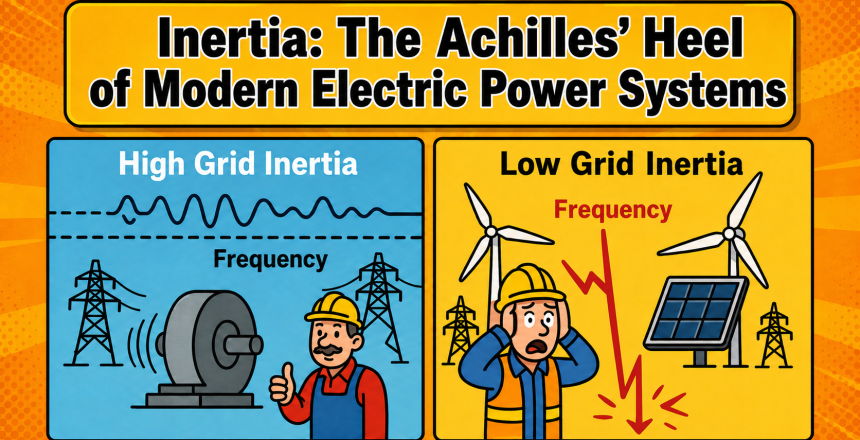
For decades, inertia was a natural byproduct of traditional systems, provided by large synchronous generators—hydroelectric, gas turbine, steam, or nuclear—that rotate at the grid frequency. This rotational motion stores kinetic energy which, in the event of any disturbance, is automatically released. This energy acts as a physical damper , slowing down abrupt changes in frequency and providing a buffer for protection and control systems to react in time.
Its primary role is to withstand sudden frequency variations that occur when there is an unexpected imbalance between generation and demand. Unlike other mechanisms, inertia does not require sensors, algorithms, or human decisions : it acts immediately, within the first millisecond of the event.

Why is it so important?
Because it provides something fundamental: time to react .
When a power plant suddenly goes offline or demand increases abruptly, the system frequency begins to drop. Inertia slows this drop, providing vital seconds for automatic backups, frequency controls, and ultimately, operators to take action. Without it, systems can collapse in a matter of seconds.
A network with high inertia behaves like a heavy train: difficult to suddenly deflect. A network with low inertia, on the other hand, is like a skate on ice: any disturbance can trigger a loss of control.
And what does it have to do with stress problems?
Although inertia acts directly on frequency , its presence has an indirect—but crucial—effect on voltage stability .
When the frequency drops abruptly, multiple generators or loads may automatically disconnect for protection. This results in the loss not only of active power (which drives the loads) but also of reactive power , which is responsible for maintaining voltage levels in the grid.
In networks with low inertia, these disconnections occur faster and in a disorderly manner, which aggravates voltage drops and can lead to combined frequency and voltage collapses.
Therefore, although inertia does not directly correct the voltage, it helps to sustain the integrity of the system in the first few seconds of a disturbance, significantly reducing the risk of cascading system failures.
What about modern variable renewable energies?
Unlike traditional synchronous generators, most modern renewable technologies—such as solar photovoltaics and much of wind power—are connected to the grid via electronic inverters . This means they are not physically coupled to the electrical system and, therefore, do not directly contribute natural inertia .
In the case of solar photovoltaics , generation depends exclusively on electronic converters, without rotating masses synchronized with the system frequency. In the case of wind power , while technologies exist that can provide some inertia—such as fixed-speed induction generators or doubly-fed induction generators (DFIGs)—the most common wind turbines today use full converters , which are completely decoupled from the electrical grid. These converters could be configured to offer synthetic inertia or grid-forming operating modes , but this is not yet standard practice, mainly due to cost, operational complexity, and the lack of clear market signals that would remunerate these services.
And here a second, even more critical problem arises:
When these systems detect a frequency outside their operating range, they tend to automatically disconnect to protect themselves , removing even more generation from the system just when it is most needed.
The result: No resistance. No damping. No time to react. Only seconds between the disturbance and the service interruption.
Are we doomed?
No. But we do face an urgent challenge.
As we decarbonize our systems, it is essential to redesign electricity markets and regulatory frameworks to recognize, value, and adequately remunerate the services that keep the system stable: inertia, rapid response, frequency control, and firmness . It is also crucial to strategically integrate new technologies capable of replacing the physical attributes previously provided by thermal power plants.
These services have a cost , and that cost must be transparently reflected in planning, investment, and operational schemes. Ignoring them or treating them as a free byproduct—as they were in the era of conventional synchronous generation—is a recipe for fragility.
In the energy transition, generating clean electricity is not enough. It is essential to ensure that this electricity reaches people, remains stable, and is available when it is most needed.
This requires investment, coordination, and a market design that does not only reward the cheapest kWh, but the one that can sustain the system when everything else fails.
Synthetic Inertia: Available Technologies
In electrical systems that are replacing conventional thermal generation with variable renewable sources, the loss of physical inertia represents a critical challenge to operational stability. Given this reality, it becomes essential to incorporate technologies capable of replicating—and even improving upon—this stabilizing function.
Many of these solutions have already been deployed and validated in various international markets. The real challenge is not technological, but rather one of intelligent integration, appropriate regulatory frameworks, and, above all, a willingness to invest in resilience.
The greater the renewable energy penetration, the greater the need for synthetic inertia. The larger the system, the more complex the challenge. To achieve penetration levels above 70%, investment in grid-forming (GFM) resources is required.

Below are some of the main technologies already available to provide synthetic inertia :
- Grid – forming inverters
- Ultra-fast response storage systems (such as batteries)
- Virtual Synchronous Generators ( VSG)
- Active demand management and fast bookings
These technologies are not futuristic. They are current, proven tools ready for deployment. They not only allow for the recovery of critical attributes lost with the shutdown of synchronous generation, but also form a new portfolio of essential services to guarantee the stability of electrical grids with high renewable energy penetration.
1. Grid-forming inverters
These advanced inverters allow renewable energy plants or storage systems not only to adapt to the existing grid, but also to form the grid itself . Unlike traditional ( grid-following ) inverters, which rely on an external frequency signal, grid-forming inverters :
- They establish their own voltage and frequency signal.
- They simulate the behavior of a synchronous generator.
- They provide immediate synthetic inertia in the face of disturbances.
- They can operate on islands or in weak network conditions.
They are fundamental for operating networks with high renewable penetration, especially in island systems, microgrids or scenarios with low rotational support.
2. Ultra-fast response storage systems
Electrical storage—particularly lithium-ion batteries— responds to changes in system frequency in milliseconds . This makes them ideal tools for:
- Provide primary and secondary frequency regulation.
- To supply active power in sudden drops.
- Stabilize momentary oscillations without needing to turn on thermal circuit breakers.
- Provide voltage support (with suitable inverters).
In more mature markets, batteries already participate as providers of auxiliary services with specific rapid response contracts.
3. Virtual Synchronous Generators (VSG)
These are systems—generally based on inverters—programmed to emulate the dynamic behavior of a synchronous generator , including its virtual rotating mass. Their key characteristics are:
- They simulate the physical inertia and electromagnetic torque of a real machine.
- They provide active frequency and voltage control.
- They are particularly useful in hybrid networks (renewables + storage).
- They improve angular stability and oscillation damping.
They function as a “bridge” between the electronic world of inverters and the physical needs of the traditional electrical system.
4. Active demand management and quick bookings
Demand is no longer a passive actor. Through automation systems, aggregators, and response to price or frequency signals, demand can be disconnected, shifted, or reduced in seconds to alleviate the system during critical moments.
The tools include:
- Demand response (DR) programs remunerated by firm power or availability.
- Automated switches and smart loads in industry and commerce.
- Aggregators that manage portfolios of small loads in a centralized manner.
- Coordination with system operators in fast booking or contingency markets.
Taken together, these measures provide operational flexibility and help prevent mass disconnections due to overload or instability.
How are Stability Services remunerated?
One of the biggest challenges of the energy transition is not only technological, but also economic and regulatory: who pays for the stability of the system?
Historically, services such as inertia, primary frequency control, and voltage support were provided free of charge by thermal power plants, simply by virtue of their operation. They were not considered independent services, nor were they assigned an explicit economic value. But in a system where these units are operating less and less—or have been completely removed from dispatch—it is urgent to recognize and remunerate these services as an essential part of market design.
In many countries, remuneration for stability services is still limited, fragmented, or nonexistent. However, there has been concrete progress:
- 🇬🇧 United Kingdom : Operator National Grid ESO has launched mechanisms such as Dynamic Containment and specific contracts for synthetic inertia , which remunerates suppliers such as grid-forming batteries and inverters .
- 🇦🇺 Australia : Within the redesign led by the Energy Security Board (ESB) , markets dedicated to stability and firmness services are being developed.
- 🇨🇱🇨🇴🇲🇽 Chile, Colombia and Mexico : there are payments for complementary services or reservations, but explicit remuneration for inertia or frequency response is still in early stages or limited to bilateral agreements.
What is clear is that resilience cannot be demanded without a framework that values it economically . Just as firm capacity or backup generation is remunerated, the ability to maintain the system in equilibrium in the face of extreme shocks must also be compensated.
If stability is not adequately compensated, there is a risk of depending on services that are not guaranteed.
And what about flexibility?
Although this article has focused on stability—and inertia in particular—it should not be forgotten that operational flexibility is equally vital in the energy transition. Without ramp capacity, storage, demand response, and rapid reserves, even stable systems can collapse in the face of renewable variability.
Flexibility allows the system to adapt to predictable but dynamic changes in generation or demand. A system can be technically stable—that is, have good inertia and response to disturbances—but still collapse if it cannot keep up with the changing conditions of daily dispatch.
This is especially important in grids with high penetration of variable renewable energy (VRE) , such as solar and wind, where generation changes significantly throughout the day or between seasons. The problem is not unpredictability, but the need for a much more agile grid.
What happens when it is missing?
The typical consequence is not an immediate collapse, as in cases of low inertia, but an accumulation of operational stresses: spillage of renewables, congestion on lines, inefficient use of thermal units or, in the worst case, preventive load cuts.
These effects have been observed in different contexts:
- 🇨🇱 Chile : abundant solar generation at midday that could not be shifted into the evening due to a lack of storage and available ramps.
- 🇨🇴 Colombia : The El Niño phenomenon reduced water resources, leaving the system without sufficient backup alternatives in critical moments.
- 🇺🇸 Texas : Extreme heat waves pushed operations to the limit, demonstrating that flexibility depends not only on how much is generated, but on when and how it can be generated.
Flexibility ≠ Reserve
I think it’s important to clarify that flexibility doesn’t simply mean having “reserve” or idle capacity . Rather, it means having assets capable of responding actively , quickly, and efficiently to the actual operating conditions of the system. For example, a thermal power plant that takes hours to start up cannot be considered flexible . In contrast, a gas turbine that comes online in just a few minutes is .
Conclusion
As we move towards cleaner, more decentralized systems, we can’t afford to ignore the fundamental physics that keeps everything in balance. Inertia is invisible. It’s not traded as a commodity, but without it, electricity shuts down. And with it, hospitals, communications, supply chains, and much of the digital economy collapse. Stability isn’t a luxury: it’s a non-negotiable prerequisite.
Similarly, system flexibility should not be viewed as an optional or secondary attribute. It is what allows for the efficient integration of renewables, reduces operating costs, prevents spills, and enables a response to extreme events without jeopardizing continuity of supply. Insufficient flexibility is like building a dead-end highway: sooner or later, everything becomes congested.
Both capabilities—stability and flexibility—require an urgent review of regulatory frameworks, planning models, and remuneration mechanisms. Market design must evolve to explicitly recognize these services, promote their provision through multiple technologies (renewables, storage, demand-side energy), and ensure their availability when most needed. The energy transition will not be successful if it depends solely on the economic merit of the cheapest kWh.
The good news is that solutions exist. Technology has advanced enough to enable 100% clean, reliable, stable, and resilient grids. But achieving this requires bold decisions, strategic investments, and an institutional framework that rewards not only efficiency but also reliability. Because in the new energy system, true value lies not only in generating electricity but in ensuring that this electricity—whether renewable or not—can sustain the system when everything else fails.
References
Blackouts, what causes them? -Mayo 2025 https://unpopular-truth.com/2025/05/16/blackouts-what-causes-them/
The uncomfortable truths of the energy transition https://www.linkedin.com/posts/juliodiazcohen_antonio-turiel-las-verdades-inc%C3%B3modas-de-activity-7327301933017276416-dAPY?utm_source=share&utm_medium=member_desktop&rcm=ACoAAAX0ZcwBuYGyeCdi1Amyoj9vcZDBso8DogE
Iberian Peninsula blackout of 2025 https://es.wikipedia.org/wiki/Apagón_en_la_península_ibérica_de_2025
2024: The year the power went out and came back to Ecuador https://www.primicias.ec/economia/crisis-electricidad-cortes-luz-resumen2024-86508
The key points of the massive blackout that left Chile without power and exposed the fragility of its system https://www.swissinfo.ch/spa/las-claves-del-gran-apagón-que-dejó-a-chile-sin-luz-y-mostró-la-fragilidad-de-su-sistema
Will the Texas heat wave cause power outages? Here’s what the authorities say https://www.elfinanciero.com.mx/border/2023/06/15/la-ola-de-calor-en-texas-provocara-apagones-esto-es-lo-que-dicen-las-autoridades
Pakistan suffers a major power outage after a failure in the electricity grid https://es.euronews.com/2023/01/23/pakistan-electricity
Colombia’s electrical system: an urgent challenge https://www.eje21.com.co/2024/10/el-sistema-electrico-de-colombia-un-desafio-urgente/
Chile – Minimum Technical Requirements for Grid-Forming Inverter-Based Resources – April 2025 https://www.coordinador.cl/wp-content/uploads/2025/04/2025.04.02-Requisitos-Minimos-para-IBR-GFM.pdf
The Spanish Electricity Sector of the Future: Challenges and Policies – December 2018 https://www.iit.comillas.edu/documentacion/informetecnico/IIT-18-153I/El_sector_el%c3%a9ctrico_espa%c3%b1ol_del_futuro:_retos_y_pol%c3%adticas.pdf
General Criteria for the Protection of the Spanish Electrical System – May 2024 https://www.ree.es/sites/default/files/00_CONOCENOS/Documentos/codigos_de_red/Criterios_Generales_de_Proteccion_del_Sistema_Electrico_Espanol_Version_consolidada_tras_consulta_OS.pdf
Meeting the Challenge of Reliability on Today’s Electric Grids: The Critical Role of Inertia https://www.oxfordenergy.org/wpcms/wp-content/uploads/2023/09/Insight-135-Meeting-the-Challenge-of-Reliability-on-Todays-Electricity-Grids.pdf