


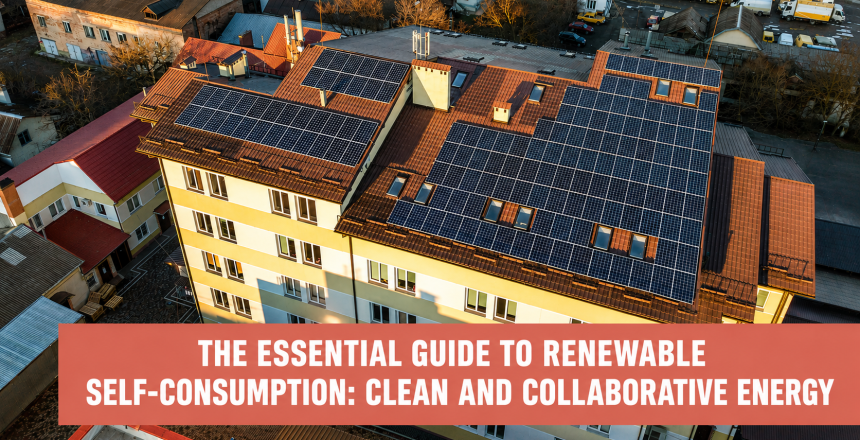
Self -consumption of renewable energy has become a growing trend and a key element in the transition to a more sustainable, decentralized, and participatory energy model. This approach allows consumers to generate their own renewable energy to meet their needs, whether in homes, businesses, or industries. Thanks to this, users can become “prosumers”—that is, both consumers and producers—with the ability to store, share, and sell their energy on the electricity market.
Until recently, consumers were only subject to protection policies aimed at ensuring their right to be connected to the networks; to receive electricity supply at transparent, non-discriminatory and clearly comparable rates and prices; to avoid disconnections from the network; with guarantees of being able to choose their supplier.
Today, thanks to self-consumption, consumers play an active role in energy efficiency, helping to reduce losses in the transmission and distribution of electricity.
Renewable energy self-consumption is defined as the production of renewable energy by one or more consumers for their own use. The main sources include solar photovoltaics, wind, biomass, and hydropower.
Benefits of Renewable Energy Self-Consumption
Energy self-consumption offers a wide range of benefits to consumers and the system, both economic and environmental:
- Economic savings: By generating their own energy, consumers can significantly reduce their electricity bills.
- Energy independence: Allows consumers to reduce their dependence on electric companies and energy price fluctuations.
- Sustainability: The use of renewable energy for self-consumption helps reduce consumers’ carbon footprint, contributing to the fight against climate change.
- Consumer empowerment: It allows consumers to take greater control of their energy supply and actively participate in the transition to a more sustainable and decentralized energy model.
Collective Renewable Self-Consumption (ARC)
Collective renewable self-consumption is an innovative and efficient method of generating and consuming energy that is gaining popularity worldwide. Unlike individual self-consumption, where a single person or entity generates renewable energy on their own property for their own use, collective self-consumption allows a group of people or entities to share a renewable energy generation facility located near consumption, such as photovoltaic solar panels, and benefit from the energy generated. This is done through energy communities, energy cooperatives, or other associative structures.
Collective self-consumption allows any consumer to access renewable energy, regardless of size and without needing to own their own property. Furthermore, it fosters the creation of energy communities, which are groups of citizens who join together to generate, consume, and manage their own renewable energy. These communities can carry out various activities, such as generation, distribution, supply, consumption, aggregation, energy storage, the provision of energy efficiency services, or the provision of electric vehicle charging services.
The primary purpose of an energy community should be to provide economic, environmental and social benefits to its partners or members, or to the local areas where it operates , rather than purely financial gains.
Main Advantages of the ARC
Collective renewable self-consumption offers numerous advantages for both consumers and society as a whole:
- Higher profitability: The investment in a collective self-consumption installation is quickly recouped thanks to economies of scale and greater utilization of the energy generated.
- Diversity of connections: Collective self-consumption installations can be connected through internal networks, low voltage networks or cadastral reference, which facilitates their adaptation to different environments and needs.
- Community impact: Collective self-consumption generates environmental, economic and social benefits for the local community, such as the reduction of greenhouse gas emissions, job creation and the strengthening of the social fabric.
- Citizen empowerment: Collective self-consumption allows citizens to take control of their own energy, participating in its generation and management.
- Promoting the energy transition: Collective self-consumption contributes to accelerating the transition towards a more sustainable and renewable energy model.
Typically Available Connection Modes
Generally, the ARC is offered in two main electrical connection modes, each with its own characteristics and requirements:
- Connection via the Internal Network

In this system, the generating installation is connected directly to the internal network of the consumers participating in the collective self-consumption. This option is ideal for apartment buildings, residential communities, or industrial parks where consumers share the same internal network.
Advantages:
- Simplicity: Connecting to the internal network is generally simpler and cheaper than connecting through the distribution network.
- Greater control: Consumers have greater control over the energy generated and consumed, as they share the same network.
- Optimizing consumption: Enables better energy management and greater efficiency in consumption.
Requirements:
- Agreement between participants: An agreement is necessary between all consumers participating in collective self-consumption, establishing the criteria for energy distribution and the responsibilities of each one.
- Generation meter: A generation meter is required to measure the energy produced by the installation and distribute it among consumers.
2. Connection via the Distribution Network

In this system, the generating installation is connected to the electricity distribution network, and consumers connect through their individual supply points. This option is suitable for larger collective self-consumption installations or for cases where consumers do not share the same internal network.
Advantages:
- Greater flexibility: It allows for the participation of a greater number of consumers and adapts to different configurations.
- Access to surplus compensation: Consumers can opt for the surplus compensation scheme, where excess energy is fed into the grid and compensated on the electricity bill.
Requirements:
- Belonging to the self-consumption with surpluses scheme: It is mandatory to belong to this scheme in order to connect through the distribution network.
- Low Voltage Connection: Consumers are usually located no more than 500 or 2000 meters apart from their respective metering equipment. In other cases, they must belong to the same cadastral reference.
- Generation meter: A generation meter is required to measure the energy produced by the installation and distribute it among consumers.
- Individual meters: Each consumer must have an individual meter to measure their energy consumption.
Examples of Collective Renewable Self-Consumption
There are numerous examples of this type of self-consumption worldwide. Some of the most notable are:
1. Energy communities in residential buildings
In Spain, Royal Decree 244/2019 has promoted collective self-consumption in residential buildings, allowing residents to install solar panels on their rooftops and share the energy generated. This initiative reduces electricity bills and fosters sustainability. Despite these advances, the adoption of this model still has significant growth potential, currently representing less than 1% of installed self-consumption capacity.
2. Self-consumption cooperatives
Self-consumption cooperatives are organizations of citizens who join together to install and manage renewable energy generation facilities, distributing the energy among their members. These cooperatives have proliferated in Europe, especially in countries with favorable legislation such as Germany, Denmark, and the Netherlands.
- Denmark: The Middelgrunden cooperative, in collaboration with the Copenhagen Environment and Energy Office, co-owns an offshore wind farm that supplies 4% of the city’s energy. More than 100,000 Danish families participate in wind energy cooperatives.
- Belgium: Ecopower, a cooperative with nearly 60,000 members, provides renewable energy through various facilities, including wind turbines, hydroelectric plants and photovoltaic plants.
Renewable energy cooperatives not only focus on the production and sale of electricity, but also promote energy efficiency. For example, the Energy Community Tipperary Cooperative in Ireland provides financial and administrative support for home insulation and improvement projects, boosting the local economy and strengthening the community.
Other activities carried out by cooperatives include energy storage, district heating, combating energy poverty and sustainable mobility, including electric carsharing models.
3. Industrial parks and office buildings
Companies located in the same industrial park or office building can join together to install a renewable energy generation facility and share the energy generated, reducing their production costs and promoting sustainability in the business sector.
4. Municipal initiatives
Some municipalities are implementing collective self-consumption projects in public buildings, such as schools or sports centers, generating renewable energy for their own consumption and promoting citizen participation in the energy transition.

How the ARC works
Collective self-consumption is based on the creation of an energy community in which several consumers join together to install and manage a shared energy generation plant. This installation can be located in a residential building, an industrial park, one or more single-family homes within a housing development, or in a communal area.
Energy distribution and use
The energy generated is distributed among the members of the energy community to meet their consumption needs. If production exceeds demand, the surplus can be fed into the electricity grid, allowing participants to receive financial compensation.
One of the main benefits of collective self-consumption is the economy of scale, which reduces investment costs compared to individual self-consumption. However, managing these installations is more complex due to the need to coordinate with multiple energy suppliers, install individual and generation meters, and manage documentation among various self-consumers.
Role of Self-Consumption Managers
To facilitate these processes, Self-Consumption Managers emerge, professionals who advise and assist developers and installers in the management of shared energy projects, streamlining procedures and ensuring regulatory compliance.
Digital tools for energy allocation
The distribution of generated energy can be optimized using advanced digital tools with artificial intelligence, which allow:
- Analyze the generation capacity of the renewable plant.
- Consider meteorological factors and consumption patterns.
- Integrate energy storage systems.
- Establish fixed or hourly distribution coefficients for each supply point, maximizing self-consumption and minimizing surpluses.
Agreement on the Distribution and Management of Surpluses
Users sign an Energy Sharing and Management Agreement , which defines the criteria and coefficients for distributing the electricity generated. These coefficients are typically adjusted two or three times a year to reflect changes in each user’s demand. The following example will help you better understand how the distribution criteria work based on the energy produced:
One plant produces 10kW for 4 homeowners.
- The first one receives 20%
- The second one, 30%.
- The other two, 25% each
In this case, the first one receives 2 kW, the second one 3 kW, and the other two ones 2.5 kW each.

Tax Incentives and Financing Options
Collective renewable self-consumption often receives tax advantages and financing options that make the implementation of these types of sustainable energy systems more accessible:
Tax Incentives
- Subsidies and public aid: This type of installation is usually supported by various government programs that encourage its implementation. For example, in Spain: For installations up to 10 kWp , the aid is €710/kWp installed . For installations between 10 and 100 kWp , the subsidy is €535/kWp installed .
- Reduction in electricity tax: In many cases, collective self-consumption is exempt from certain taxes, generating additional savings for participants.
Financing Options
- Specific loans and lines of credit: Financial institutions often offer products designed for the installation of these types of renewable energy systems, facilitating the initial investment and improving the economic viability of the project.
Conclusion
Renewable self-consumption, both individual and collective, represents a fundamental pillar in the transition to a more sustainable, decentralized, and participatory energy model. Its implementation allows consumers to reduce energy costs, increase their independence from traditional grids, and actively contribute to reducing carbon emissions. As technology advances and new regulations are developed, this model will continue to gain relevance in the global energy landscape.
Collective self-consumption, in particular, democratizes access to renewable energy by allowing multiple users to share electricity generation and consumption without needing their own infrastructure. This approach fosters the creation of energy communities, promotes collaboration between citizens and businesses, and strengthens the energy resilience of cities and regions. Furthermore, government support through tax incentives and financing options facilitates its adoption and expansion.
Looking ahead, the integration of advanced digital tools, artificial intelligence, and energy storage will further optimize the efficiency and management of renewable self-consumption. Active consumer participation in energy generation and distribution will be key to accelerating the energy transition, promoting a more equitable and sustainable system aligned with emissions reduction and climate change mitigation goals.
References
Self-consumption: The future of Distributed Generation
Regulations on Self-Consumption in Spain
https://www.miteco.gob.es/es/energia/energia-electrica/electricidad/autoconsumo-electrico.html
https://www.idae.es/tecnologias/energias-renovables/oficina-de-autoconsumo
Guide to collective self-consumption in Spain
https://www.idae.es/publicaciones/guia-de-autoconsumo-colectivo
Shared energy: transforming into opportunities
https://elperiodicodelaenergia.com/energia-compartida-transformacion-en-oportunidades