

In an increasingly electricity-dependent economy, generating electricity is no longer enough. The ability to transmit, distribute, and sustainably finance electricity infrastructure is becoming one of the key determinants of national competitiveness and economic growth.
Imagine a company with the financing, technology, and market demand to build a new factory, but unable to begin operations because the electricity grid lacks sufficient capacity.
Or a data center that can be built in less than three years, but whose connection depends on infrastructure that could take considerably longer to develop.
In both cases, electricity is no longer simply an operating cost. It becomes a prerequisite for turning new investments into reality.
This reality is particularly relevant as artificial intelligence, data centers, industrial automation, and electric mobility continue to expand.
For decades, the energy debate focused on how to generate enough electricity at competitive prices. Today, we must incorporate two fundamental questions:
- ¿Do we have the electricity grids needed to transmit and deliver power where and when it is needed?
- ¿Do we have an economic and financial model capable of sustaining, modernizing, and expanding those grids?
The answer is more complex than it may seem.
On one hand, transmission and distribution constraints can delay investments and prevent the full utilization of available energy resources. On the other, commercial losses, poorly designed subsidies, and financial imbalances can restrict the resources needed to develop that infrastructure.
Although they have different origins, both constraints can reinforce each other and become structural barriers to economic development.
The challenge, therefore, is not simply to generate more electricity, but to ensure that it can reach consumers through a technically and financially sustainable system.
To better understand this relationship, we will first examine the physical and financial constraints facing electricity systems. We will then explore how these dynamics manifest themselves in two case studies: the Dominican Republic and Panama, two markets with different realities but challenges that are critical to competitiveness, public finances, and the well-being of their populations.
1. Electricity as Strategic Infrastructure
Electricity has always been essential to industrial development. However, its importance is reaching a new dimension.
A power outage no longer means only that a factory must stop its machines. It can also disrupt financial transactions, telecommunications, hospital services, digital platforms, and automated processes.
As economies integrate more digital technologies, the consequences of insufficient or unreliable electricity supply multiply.
This growing dependence is also transforming how we must plan and develop electricity systems.
1.1. When Grids Fail to Keep Pace with Generation and Demand
In recent years, the energy industry has made extraordinary progress in developing new generation technologies, particularly solar and wind power.
However, while these technologies can be deployed modularly and within relatively short timeframes, expanding the grids needed to transmit and distribute electricity often takes much longer. Several factors explain this difference:
- Long development timelines: Planning, environmental permitting, securing rights-of-way, and construction processes can significantly extend project schedules.
- Supply chains under pressure: Essential equipment, such as power transformers and specialized cables, is subject to increasingly challenging manufacturing and delivery lead times.
- Regulatory complexity: As infrastructure with natural monopoly characteristics, electricity grids require stable regulatory frameworks that enable the recovery of long-term investments.
- Financial constraints: Delayed tariff adjustments, insufficiently funded subsidies, and inadequate investment recovery mechanisms can hinder grid modernization and expansion.
According to the International Energy Agency (IEA), more than 2,500 GW of renewable generation, energy storage, and new electricity demand projects remain in grid connection queues worldwide.
Furthermore, while certain grid infrastructure projects may require 5 to 15 years to develop, a data center can be built in just 1 to 3 years.

This mismatch introduces a fundamental shift in energy planning: the physical availability and deliverability of electricity, rather than total installed generation capacity, may determine where and when new investments materialize.
In other words, producing electricity at competitive prices is not enough. We must also ensure that it can be delivered where it is needed, when it is needed.
1.2. Curtailment: When Energy Is Available but Cannot Be Used
Chile provides one of the most illustrative examples of this reality in Latin America.
The country’s rapid expansion of solar and wind generation has, at certain locations and times, exceeded the transmission and absorption capacity of its electricity system.
According to ACERA figures referenced in this research, approximately 6,084 GWh of solar and wind energy were curtailed in 2025, representing a 7.8% increase compared with 2024.
This phenomenon, known as curtailment, occurs when a portion of potentially available electricity generation cannot be injected into the grid due to technical, operational, or economic constraints.
Its consequences extend beyond wasted energy. Curtailment can also reduce generators’ revenues, affect project profitability, and create uncertainty for future investments.
Battery energy storage is helping mitigate these constraints by allowing energy to be used during periods of higher demand. However, storage cannot fully replace the need to expand and modernize electricity grids.
https://www.reporteminero.cl/noticia/noticias/2026/07/bess-chile-almacenamiento-energia-mineria
Chile’s experience demonstrates that generation, transmission, distribution, storage, and demand must develop in a coordinated manner.
Otherwise, a country may possess abundant energy resources while simultaneously struggling to realize their economic value.
Yet infrastructure constraints are not always physical. There is another equally important limitation: the financial capacity to sustain the investments required by the electricity system.
1.3. Technical and Non-Technical Losses: When Electricity Fails to Generate Revenue
Electricity grids are capital-intensive infrastructure assets whose investments must be recovered over periods that can span decades.
Their sustainability depends on stable regulatory frameworks, adequate cost-recovery mechanisms, and, fundamentally, the timely collection of revenues.
When these revenue streams become insufficient or uncertain, the ability to maintain and expand infrastructure is compromised.
One of the main challenges in many markets is electricity losses, which can be classified into two categories:
- Technical losses: These are inherent to electricity transmission and distribution and result from physical phenomena such as the Joule effect and transformer losses. Although unavoidable, they can be reduced through investment, equipment modernization, and grid optimization. In modern and efficient systems, total electricity losses should generally remain below 10%, as observed in countries such as Chile and Uruguay, where they are approximately 6–8%. While unavoidable, technical losses can be mitigated through grid investment and operational modernization.
- Non-technical or commercial losses: These include electricity consumed but not properly billed due to illegal connections, meter tampering, measurement errors, and deficiencies in commercial processes.
An additional, distinct but equally important problem is the failure to collect payment for electricity that has already been billed.
To illustrate the impact, imagine a distribution company that purchases 100 units of electricity but manages to bill only 80 and collect payment for an even smaller proportion.
Even if its selling tariff is higher than its purchase price, the company may still struggle to recover its costs.
When these inefficiencies persist, their consequences are ultimately absorbed by electricity companies, other consumers, or the government.
Non-technical losses and persistent nonpayment can effectively function as forms of implicit subsidies, even though they do not necessarily constitute budgeted government subsidies.
When losses and collection deficiencies reach high levels, they cease to be merely operational problems and become structural constraints on the sector’s financial sustainability.
1.4. Electricity Subsidies: Balancing Social Protection and Financial Sustainability
Electricity subsidies serve important social and economic purposes. They help protect vulnerable households, facilitate access to electricity, and cushion the impact of extraordinary increases in energy prices.
Therefore, the problem is not necessarily their existence, but rather how they are designed, who benefits from them, and how they are financed.
A well-targeted, transparent, and adequately funded subsidy can be fully compatible with a sustainable electricity sector.
Difficulties arise when subsidies become generalized, remain in place indefinitely without adequate financing, or are used to compensate for structural inefficiencies that should instead be corrected.
Their effects can manifest in several ways:
- Insufficient tariffs: When tariff revenues and compensation payments do not cover the efficient costs of providing electricity service, financial imbalances emerge.
- Delayed government transfers: When government subsidy commitments are not paid on time, electricity companies may face liquidity problems.
- Deterioration of the payment chain: Financial constraints at distribution companies can lead to delayed payments to generators and suppliers, increasing counterparty risk.
- Greater financial and fiscal risk: Uncertainty over revenue recovery can increase financing costs and constrain new investments, while recurring government transfers place additional pressure on public finances.
In this way, a mechanism originally intended to protect consumers can, when poorly designed or inadequately funded, ultimately weaken the electricity system’s investment capacity.
1.5. The Vicious Cycle: When Physical and Financial Constraints Reinforce Each Other
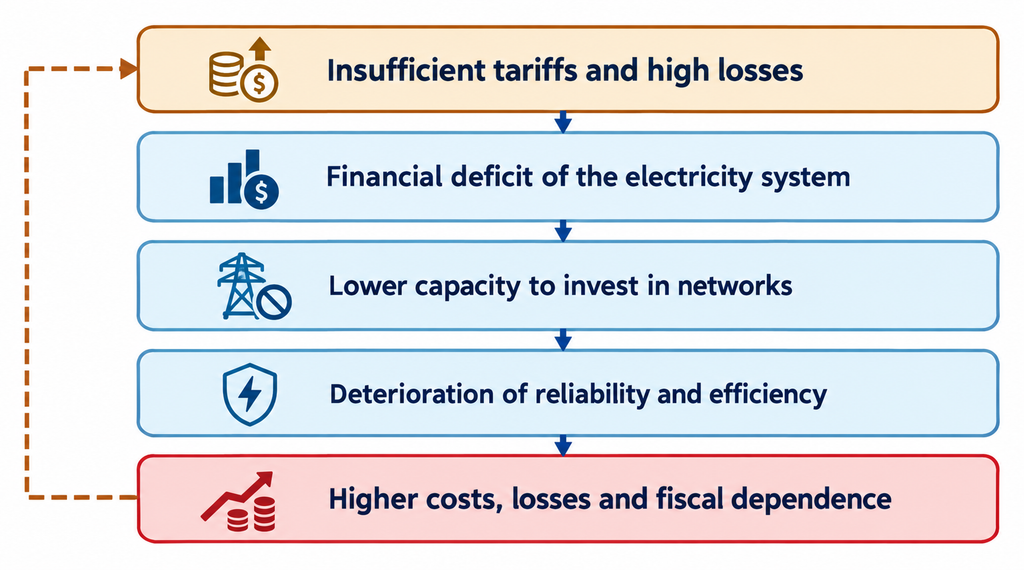
Electricity losses, subsidies, and investment needs are not independent challenges. Under certain conditions, they can reinforce one another.
When a significant share of electricity is not billed, revenues are not collected, or government compensation payments are delayed, utilities may lose the financial capacity to invest in maintenance and modernization.
Lower investment can deteriorate grid efficiency and reliability, increasing technical losses and operating costs.
In turn, poor service quality, combined with institutional and commercial weaknesses, can make revenue recovery more difficult and increase dependence on financial support.
This creates a vicious cycle:
Its effects can extend far beyond the electricity sector. Public resources allocated to offset recurring financial imbalances may compete with investments in education, healthcare, transportation, and infrastructure.
At the same time, businesses facing unreliable electricity supply may be forced to invest in backup generation, absorb additional costs, or postpone new investments.
This is why an electricity-sector problem can become a broader challenge for productivity, competitiveness, and fiscal sustainability.
Breaking this cycle requires simultaneous action to modernize electricity grids, reduce losses, improve commercial efficiency, strengthen regulatory quality, and better target subsidies.
I am not suggesting eliminating social protection or indiscriminately passing costs on to consumers. Rather, the objective is to better protect those who need support while ensuring that the electricity system has sufficient resources to operate, maintain itself, and grow.
It is precisely at this point that grid modernization and the financial strengthening of the electricity sector cease to be separate efforts and become two essential components of the same transformation.
Because an increasingly electricity-dependent society cannot build its future on infrastructure that lacks the resources needed to maintain, modernize, and expand itself.
2. Dominican Republic: A Macroeconomic Challenge
The physical and financial constraints facing the electricity sector become particularly significant when examining the Dominican Republic.
Over recent decades, the country has experienced substantial economic growth and considerably expanded its electricity generation capacity. However, these achievements have coexisted with structural problems in electricity distribution, characterized by high losses, collection difficulties, and persistent dependence on government transfers.
What might initially appear to be an operational challenge within the electricity sector has become a macroeconomic issue, with consequences for public finances, competitiveness, and the country’s investment capacity.
The Scale of Electricity Subsidies
The figures illustrate the magnitude of the challenge:
- Cumulative cost: Between 2000 and 2025, the Dominican Republic allocated approximately US$17.24 billion to electricity subsidies, equivalent, on average, to 1.0% of GDP and 25.3% of the Central Government’s annual fiscal deficit. To put this into perspective, this amount represents more than three times the investment required for the Panama Canal expansion (US$5.25 billion). Over the past decade alone, subsidies totaled US$10.32 billion, nearly twice the cost of that expansion.
- Growing trend: Annual subsidies increased from US$959 million in 2021 to US$1.67 billion in 2025. Approximately US$1.96 billion is projected for 2026, compared with the US$1.58 billion initially approved in the national budget. For 2027, subsidies of US$1.93 billion are anticipated, of which approximately 45% would correspond to EdeEste. During the first half of 2026 alone, government transfers reached US$960.4 million, a 40.2% year-over-year increase. The main contributing factors include electricity losses approaching 40%, the tariff freeze in place since July 2022, rising fuel costs, and growing electricity demand.
- Economic impact: In June 2026, distribution companies purchased electricity at an average price of 15.58 US cents per kWh and sold it at 17.45 US cents per billed kWh. However, with economic recovery equivalent to only 58% of the electricity purchased, the effective purchase cost per recovered kWh reached approximately 26.9 US cents. This represents a gap of nearly 35% relative to the average selling price, even before accounting for other operating costs.
- Scope of subsidies: The broad tariff freeze introduced in 2022 benefits consumers across different income levels. In June 2026, of approximately 3.31 million active customers, only 2.48 million recorded payments during that month, leaving around 828,000 customers (25%) without recorded payments during the period. Meanwhile, the targeted Bono Luz program, which covers up to 100 kWh per month, benefited approximately 533,000 households as of March 2024.
These figures reflect a problem that extends well beyond electricity prices. When a significant portion of supplied electricity does not generate adequate financial recovery, the sector’s financing needs increase and ultimately affect public finances, either directly or indirectly.
The result is a difficult cycle to break: losses weaken distribution companies’ finances, insufficient resources limit the investments needed to improve electricity grids, and operational deficiencies perpetuate financial imbalances.
The comparison with the Panama Canal expansion helps illustrate the opportunity cost of these resources. While an infrastructure investment can create productive capacity and generate revenues for decades, subsidies used to cover recurring deficits sustain the system’s operations without necessarily addressing the underlying causes of its deterioration.
The solution, therefore, cannot be limited to adjusting tariffs or expanding generation capacity. It requires coordinated action to reduce losses, improve metering and collections, strengthen operational efficiency, enhance service quality, and better target subsidies.
The real challenge is to transform resources currently used to finance recurring deficits into investments and improvements capable of reducing those deficits in the future.
3. Panama: Tariff Stabilization Subsidies and Service Quality
Panama presents a different reality from the Dominican Republic, although it shares challenges related to financial sustainability, infrastructure investment, and electricity supply reliability.
Its electricity market operates with unbundled activities, regulated distribution companies, and specific mechanisms designed to stabilize the tariffs paid by consumers.
Unlike the Dominican Republic, Panama’s subsidies do not necessarily arise from the same commercial imbalances. Their primary purpose has been to cushion the impact of cost fluctuations on electricity tariffs, although they also raise questions about fiscal sustainability, targeting, and long-term effects.
The Scale of Electricity Subsidies
- Cumulative cost: According to data from Panama’s National Authority of Public Services (ASEP), electricity subsidies totaled approximately US$2.55 billion between 2010 and December 2024. Extending the analysis back to 2004 brings the cumulative amount to approximately US$3.3 billion.
- Recent developments: Reported figures show US$137.3 million in 2024 and US$274.1 million in 2025, with approximately US$188 million projected for 2026 through the Tariff Stabilization Fund (FET) and the Western Region Tariff Fund (FTO). These financing needs reflect, among other factors, fluctuations in fuel costs, growing demand, and unfavorable hydrological conditions.
- Impact on tariffs: In January 2026, the average electricity price was 20.82 US cents per kWh, while the average price after subsidies stood at approximately 19.12 US cents per kWh.
- Coverage: In 2024, approximately 48.49% of customers received some form of tariff subsidy, totaling US$57.18 million. During the second half of 2025, the FET benefited approximately 930,000 customers consuming up to 300 kWh per month.
These figures correspond to the categories and periods reported by their respective sources. Budgeted, authorized, and actually disbursed amounts are not always directly comparable.
These mechanisms have helped protect consumers and provide greater stability against cost fluctuations. However, their efficiency, targeting, and fiscal sustainability must be continuously evaluated.
At the same time, Panama faces significant needs to expand and modernize its electricity infrastructure. These include the development of the fourth transmission line, a project that has experienced delays, and the electrical interconnection with Colombia, which has yet to materialize.
These investments are essential to increase transmission capacity, improve operational flexibility, and facilitate more efficient utilization of available energy resources.
However, transmission expansion must be accompanied by improvements in distribution, where significant differences in service quality persist, particularly between urban and rural areas.
Consequently, although the Dominican Republic and Panama have different market structures and face distinct challenges, both cases lead to the same conclusion:
Electricity-sector sustainability depends not only on maintaining affordable tariffs, but also on ensuring that sufficient resources are available to operate, maintain, and develop the infrastructure required by the economy.
While the Dominican Republic faces the challenge of reducing losses and restoring the financial sustainability of its distribution companies, Panama must ensure that its tariff stabilization mechanisms remain compatible with the investments and service quality standards required over the long term.
4. Solutions and Recommendations: Toward Sustainable Electricity Systems
The experiences of the Dominican Republic and Panama demonstrate that, although electricity-sector challenges may have different origins, their consequences ultimately converge in three fundamental areas: financial sustainability, service quality, and the ability to attract new investments.
Overcoming these constraints requires much more than building additional power plants, expanding electricity grids, or modifying tariffs. It demands a coordinated approach to infrastructure, financing, technology, regulation, and social protection.
Based on this analysis, I propose five priority areas for action.
4.1. Transform Subsidies: Better Protection and Sustainable Financing
Subsidies must preserve their social purpose while ensuring that public resources primarily reach those who genuinely need them.
Achieving this requires moving toward targeting mechanisms based on households’ socioeconomic conditions rather than relying exclusively on electricity consumption levels. Argentina’s experience with beneficiary registries and asset-based eligibility criteria provides a useful reference for evaluating this approach.
However, better targeting alone is insufficient. It is equally important to ensure that committed funding is available when needed. Instruments such as pre-funded trusts, with disbursements linked to regulatory settlements, could reduce delays that affect distribution companies’ liquidity and the sector’s payment chain.
These measures can be complemented by gradual and predictable tariff adjustments, accompanied by direct transfers to vulnerable households where reliable mechanisms exist to identify eligible beneficiaries.
The objective should not be to indiscriminately subsidize electricity consumption, but to effectively protect those who need assistance without compromising the system’s sustainability.
4.2. Strengthen Financing and Accelerate Grid Expansion
Modernizing electricity grids requires substantial investments, with costs recovered over decades. Therefore, appropriate financial and regulatory mechanisms are essential to mobilize capital and allocate risks effectively.
Public-private partnerships (PPPs), build-operate-transfer (BOT) models, availability payments, and multilateral guarantees offer alternatives for developing strategic infrastructure.
Similarly, blended finance involving institutions such as the Inter-American Development Bank (IDB), the World Bank, the International Finance Corporation (IFC), and CAF can facilitate projects facing greater financing constraints.
However, having access to financing does not guarantee timely project execution. Experiences such as Panama’s fourth transmission line highlight the importance of anticipating challenges related to permitting, rights-of-way, and environmental and social considerations.
In parallel, regulatory frameworks should evaluate mechanisms that recognize efficient anticipatory investments, allowing infrastructure to be developed before capacity constraints become obstacles to new economic activities.
In an increasingly electricity-dependent economy, waiting until demand exceeds available capacity can be considerably more costly than planning infrastructure expansion in advance.
4.3. Make Better Use of Existing Infrastructure Through Technology
Not every electricity constraint requires the immediate construction of new transmission lines. In many cases, technology can increase the capacity and efficiency of existing facilities.
Solutions such as dynamic line rating, grid topology optimization, and advanced power flow control can improve the utilization of available infrastructure.
According to estimates by the International Energy Agency (IEA), these technologies could enable the connection of up to 330 GW of additional projects without necessarily requiring major conventional grid expansions.
Other opportunities include reconductoring existing lines, upgrading facilities, and integrating energy storage systems. In Chile, for example, batteries helped utilize approximately 2 TWh of electricity during 2025, reducing renewable energy curtailment.
Distribution digitalization offers additional opportunities. Smart metering, data analytics, and commercial process automation can help detect irregularities, reduce losses, and improve service quality.
Modernizing the electricity system does not simply mean building more infrastructure. It also means making better use of what we already have.
4.4. Integrate Demand Flexibility and Strengthen Regional Integration
Traditionally, electricity systems have sought to adjust generation to variations in consumption. However, new technologies also make it possible to manage demand to improve overall system efficiency.
Time-of-use tariffs, demand response programs, and automated load management can shift part of electricity consumption toward periods of greater energy availability, reduce congestion, and facilitate the integration of renewable energy sources.
According to IEA estimates, certain flexibility measures could reduce renewable energy curtailment by more than 25% by 2030, depending on the conditions of each market.
Regional integration represents another important opportunity to capitalize on complementarities between electricity systems.
In Central America, strengthening the Central American Electrical Interconnection System (SIEPAC) and expanding opportunities for cross-border electricity trade would allow countries to make better use of regional energy resources.
For Panama, the electrical interconnection with Colombia could diversify supply options and strengthen energy security, particularly during periods of unfavorable hydrological conditions. However, implementing the project requires adequately addressing technical, environmental, and social challenges, including consultation processes with affected communities.
Ultimately, flexibility and integration make it possible to use both infrastructure and available energy resources more efficiently, reducing the need to rely exclusively on new generation investments.
4.5. Strengthen Governance and Implement Market-Specific Reforms
No transformation can be sustainable without strong institutions, clear rules, and effective accountability mechanisms.
The technical independence of regulators, transparency regarding financial obligations, and predictability in tariff mechanisms are essential to reducing uncertainty and attracting investment.
In particular, periodically publishing outstanding government obligations to electricity companies and establishing clear mechanisms for recognizing and settling those obligations would help improve the sector’s financial discipline.
However, defining reforms is only part of the challenge. Establishing priorities and the appropriate sequence for implementation is equally important.
In the Dominican Republic, efforts should focus on reducing losses, strengthening metering and collections, improving operational efficiency, and raising service quality. These improvements must be accompanied by sustained investment and social protection mechanisms that allow distribution companies to gradually restore financial sustainability.
In Panama, the priority is to ensure that tariff stabilization mechanisms remain compatible with fiscal sustainability and the investments needed to improve electricity supply quality. This requires addressing both transmission constraints and the modernization needs of distribution networks.
In both markets, modifying tariffs without correcting operational, regulatory, and institutional inefficiencies is unlikely to resolve the underlying problems.
Transformation must begin by addressing structural causes, rather than merely financing their consequences.
5. Conclusions
The electrification of the economy, artificial intelligence, data centers, and industrial automation are transforming the role of electricity in economic development.
In this new environment, having sufficient electricity at competitive prices is essential, but it no longer guarantees that a country can fully capture opportunities for growth.
As we have seen, the ability to transmit and distribute electricity, together with the capacity to finance this infrastructure sustainably, can be just as important as generation itself.
The experiences of the Dominican Republic and Panama help illustrate this relationship from different perspectives.
The Dominican Republic demonstrates how persistent losses, commercial inefficiencies, and dependence on government transfers can turn a sector-specific problem into a macroeconomic burden that consumes public resources over decades.
Panama, operating under a different market structure, shows that tariff protection mechanisms must also be evaluated in terms of their fiscal sustainability and the investments required to ensure reliable electricity service.
Three fundamental conclusions emerge from this analysis:
1. Generating more electricity does not guarantee that we can use it. Transmission, distribution, and grid connections must expand in coordination with the growth of generation and demand.
2. Subsidies are no substitute for correcting inefficiencies. Social protection must be properly targeted without compromising financial sustainability or service quality.
3. Energy transformation must translate into development. Its success depends not only on installed megawatts or electricity prices, but also on reliability, efficiency, and its contribution to productivity and social well-being.
Ultimately, infrastructure modernization and the financial strengthening of the electricity sector are part of the same transformation. Sustainable progress in one cannot be achieved without addressing the other.
The real challenge of the coming decades will not simply be to generate more electricity, but to build systems capable of transforming energy resources into greater investment opportunities, competitiveness, and prosperity for society.
And this brings us to a question that I consider fundamental:
Are we investing enough to build the electricity system we will need tomorrow, or are we still allocating too many resources to compensate for the inefficiencies of the past?
References
Agencia Internacional de Energía. (2026). Electricity 2026: Grids. Enlace a la fuente
Agencia Internacional de Energía. (2025). Building the future transmission grid. Enlace a la fuente
Agencia Internacional de Energía. (2023). Electricity grids and secure energy transitions. Enlace a la fuente
Fondo Monetario Internacional. (2025). Dominican Republic: 2025 Article IV consultation (Country Report No. 25/305). Enlace a la fuente
Ministerio de Energía y Minas de República Dominicana. (2026). Boletín de distribución y comercialización de energía: diciembre de 2025. Enlace a la fuente
Ministerio de Economía y Finanzas de Panamá. (2026). Cuenta general del Tesoro 2025. Enlace a la fuente
Autoridad Nacional de los Servicios Públicos. (2026). Calidad de servicio eléctrico: estadísticas de 2025. Enlace a la fuente
Marchán, E., Espinasa, R., & Yépez-García, A. (2017). The other side of the boom: Energy prices and subsidies in Latin America and the Caribbean during the super-cycle. Banco Interamericano de Desarrollo. Enlace a la fuente
Pantanali, C., & Benavides, J. (2006). Subsidios eléctricos en América Latina y el Caribe: análisis comparativo y recomendaciones de política. Banco Interamericano de Desarrollo. Enlace a la fuente
Banco Mundial. (2023). Dominican Republic distribution efficiency improvement and utility strengthening project (P180512). Enlace a la fuente
Subsidio eléctrico absorbió US$10,322 millones en 10 años. https://eldinero.com.do/315486/subsidio-electrico-absorbio-us10322-millones-en-10-anos/
Performance Report -July 2026. Ministerio de Energía y Minas de República Dominicana. https://mem.gob.do/wp-content/uploads/2026/09/Informe_Desempeno_EEE_julio_2026-.pdf