

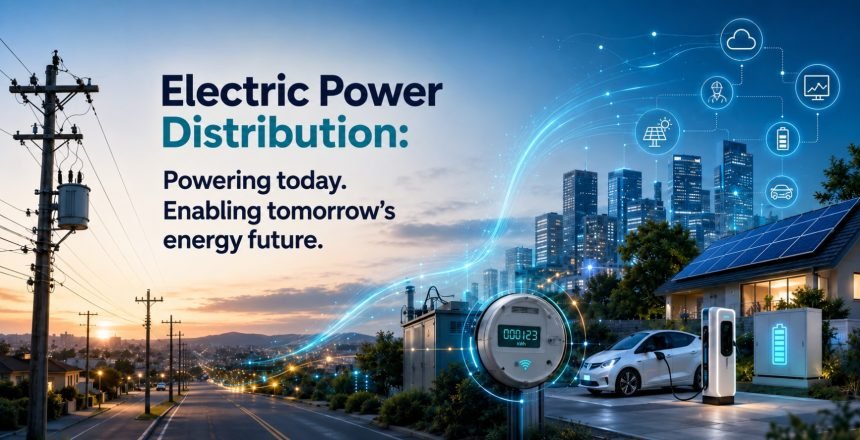
The electricity distribution business has always been treated as a natural monopoly and a highly regulated activity.
The reason is simple: it wouldn’t make economic sense to duplicate electrical networks in the same area so that several operators would physically compete to serve the same customers. Therefore, a company receives the exclusive right to operate the network in a specific area, but in return assumes strict obligations regarding service, quality, continuity, expansion, and efficiency.
This regulated condition does not diminish its importance. On the contrary, it confirms its essential nature.
Distribution is the activity that allows energy to finally reach homes, businesses, and industries with the continuity, safety, and quality that modern life demands. It is the point where the electrical system becomes tangible for the user: light in a home, refrigeration in a business, equipment running in an industry, connectivity in a city, and essential services operating every day.
However, despite its importance, distribution has rarely had the prominence of large power generation plants, nor has it generated the same technological enthusiasm as solar panels, batteries, or electric vehicles. But that is changing.
Today, the distribution network is becoming one of the most strategic assets of the energy transition. It is where users connect, where distributed energy resources appear, where mobility is electrified, where new loads are integrated, where service quality is measured, and where digitalization can completely transform the way the electricity system operates.
Therefore, discussing electricity distribution concession contracts is no longer merely a legal or regulatory issue. It’s a conversation about competitiveness, investment, service quality, innovation, and the future of energy.
This article seeks to explore how these models are evolving, what good practices international experience offers, and what adjustments will be necessary for distribution to enable the energy transition.
The real challenge is to design concessions that are not limited to managing the networks we have, but that allow us to build the networks we will need in the next 30 years.
The balance behind an electricity distribution concession
The heart of an electricity distribution concession lies in the balance between rights and obligations.
The company needs stability to invest in long-term infrastructure. The user needs reasonable costs and good service. The government needs to ensure that an essential public service is provided efficiently, continuously, and sustainably.
When this balance works, the concession becomes a powerful tool for attracting investment, improving the quality of supply, and modernizing infrastructure. When it fails, it can lead to underinvestment, deterioration of electricity service, tariff disputes, increasing energy losses, and a loss of confidence.
A concession agreement should not be a blank check. But neither can it be so short, rigid, or uncertain that it discourages investment. The key is to combine long-term stability with a constant demand for performance.
1. Long terms for long-term investments
A first lesson from international experience is that distribution concessions usually require long-term horizons.
These are not quick-recovery businesses. Electrical grids demand capital-intensive investments, with lifespans of several decades: substations, transformers, lines, control systems, automation, meters, digital platforms, and cybersecurity capabilities.
For this reason, many countries have adopted long-term concessions or even licenses without a predetermined expiration date, but always conditional on compliance with quality and efficiency standards.
In Europe , license models of indefinite duration coexist with concessions of 20 to 30 years, generally renewable and subject to compliance with performance standards. In Latin America , the experience is more heterogeneous: there are indefinite licenses, very long-term concessions, such as those granted for 95 years in some privatization processes, and more common schemes of 15 to 30 years, with renewals conditioned on the concessionaire’s performance.
The logic is clear: if the regulator continuously monitors rates, quality, and performance, the relevant issue is not only when the concession expires, but also what obligations the company has while operating and what consequences it faces if it fails to comply.
Stability does not mean a lack of control. It means clear rules for investing, operating, reviewing, and correcting.
2. Remuneration: recovering efficient costs and incentivizing better results
The second critical component is financial compensation. The central question is how to enable the distributor to recover its efficient costs, achieve a reasonable return, and, at the same time, have real incentives to improve.
Historically, many systems have used cost-based models. Under this approach, the company recovers the costs recognized by the regulator plus a rate of return on invested capital. This scheme offers certainty for investment, but it can also weaken incentives to reduce costs if all prudent spending ends up being reflected in tariffs.
Therefore, many jurisdictions have evolved toward incentive-based regulatory models, such as price caps or revenue caps. In these schemes, the regulator sets a maximum rate or revenue for a multi-year period, usually between four and five years. If the company operates below projected costs, it temporarily retains some of that efficiency gain. If it is less efficient, it absorbs some of the impact.
Then, in the next tariff review, those efficiencies are shared with users through productivity adjustments, such as Factor X. The logic is to create a useful tension: to incentivize efficiency without allowing its benefits to be permanently captured by the company.
Modern regulation should not pay any cost. It should recognize efficient costs and verifiable results.
3. Investing too much, investing too little, or investing poorly
One of the biggest regulatory challenges lies in investment. Grids need capital: they must be expanded, reinforced, renewed, automated, and prepared for distributed generation, electric vehicles, storage, industrial electrification, climate resilience, and higher quality expectations.
But there is also a risk of overinvestment. If the model primarily rewards the asset base, there may be an incentive to favor capital-intensive solutions, even if they are not always the most efficient for the system.
That’s why some countries have moved towards TOTEX ( Total Expenditure ) schemes, which treat operating expenses and capital investments in an integrated way. The idea is to avoid the artificial bias between OPEX and CAPEX. The important thing is not whether the accounting solution is an expense or an investment; the important thing is whether it solves the problem at the lowest total cost to the system.
Spain offers a particularly useful current example: the CNMC has proposed moving towards a TOTEX approach for the 2026-2031 regulatory period. Furthermore, it is considering linking part of the remuneration to the growth in demand or contracted power, to avoid investments in capacity that is not effectively used.
This approach allows for comparing alternatives: building more infrastructure, improving maintenance, automating the network, installing sensors, managing demand, or using analytics to reduce congestion and outages. The regulatory question shifts from “How much capital did you invest?” to “What results did you achieve and what was the total cost?” This change is fundamental.
4. Service quality: what the user really feels
A distribution concession cannot be measured solely by infrastructure investments or tariff costs. It must be measured, above all, by the service the user receives.
Indicators such as SAIDI ( System Average Interruption Duration Index ) and SAIFI ( System Average Interruption Frequency Index ) allow for measuring the average duration and frequency of interruptions. These are complemented by variables such as voltage quality, connection times, complaint handling, accurate billing, loss reduction, repair times, and customer satisfaction.
These indicators are key because they prevent efficiency from being achieved at the expense of service. A company can reduce maintenance costs and show better numbers in the short term, but if that translates into more interruptions, worse service, or greater losses, the system ultimately pays the price.
Therefore, best practices link part of the compensation to performance. If the company improves service continuity, it can receive incentives. If it fails to meet minimum standards, it faces penalties, compensation to users, or more severe sanctions.
Being cheap isn’t enough. You have to be efficient and reliable.
5. Electrical losses: efficiency, payment culture and sustainability
In many Latin American countries, electricity losses remain one of the main challenges of distribution.
Technical losses are unavoidable to some extent, because every network has physical losses. But non-technical losses—fraud, illegal connections, measurement or billing errors—represent an economic, social, and institutional problem.
When losses are high, someone pays for them directly: the company, compliant users, the government, or a combination of all of them. In any case, they affect the sustainability of the system.
Therefore, concession contracts typically establish gradual loss reduction targets. They may also define what level of loss reduction will be reflected in the tariff and what portion the distributor will have to assume if it fails to improve.
Reducing losses depends not only on technology. It requires investment, business management, institutional support, oversight, a culture of payment, and coordination with public authorities. A well-designed concession must acknowledge this complexity, but also prevent losses from becoming normalized as an unavoidable cost.
Different models, the same regulatory logic
International comparisons show that there is no single perfect concession model. Some countries have fixed-term concessions. Others operate with indefinite licenses. Some integrate distribution and marketing. Others separate the distributor from the marketers. Some have a national company. Others have multiple regional or local concessionaires.
This difference is key to market design. In several Latin American countries, the distributor maintains an integrated role in both network and regulated supply. In the European Union, however, the distributor acts primarily as a neutral network operator, with obligations of open access, non-discrimination, and providing information to retailers and users.
https://electron.net/uk-dnos-developing-dso-capabilities/
The ownership of the assets also changes. In some cases, the assets revert to the State upon termination of the concession. In others, they belong to the operator and must be transferred or compensated if the concessionaire changes.
These differences reflect institutional histories, public policy priorities, levels of market development, degree of private participation, and the structure of the electricity system.

But, beyond these differences, there are common principles that are repeated among these models: clear rules, a technical and independent regulator, predictable remuneration, incentives for efficiency, quality standards, balanced review mechanisms and real consequences for non-compliance.
Ultimately, designing a concession goes far beyond defining who operates the network; its true challenge lies in establishing how they do so: with what incentives, under what responsibilities, and with what results. Given that it is an essential public service, regulation cannot leave performance to chance. Its ultimate purpose must be to structure a system where efficient investment, excellent operation, and user protection are, in practice, part of the same equation.
The new challenge: digitizing the network
The natural evolution of distribution networks demands a leap toward their complete digitalization. For decades, the operational management of this activity focused on the administration of physical assets: poles, cables, transformers, and substations. However, the current needs of the electrical system require a different vision. The network must be transformed into an intelligent platform, a comprehensive data ecosystem where analytical intelligence dictates the standard of service.
In this new scenario, technologies such as smart meters, automation, advanced SCADA systems, artificial intelligence, predictive analytics, active demand management, and cybersecurity are no longer technological add-ons. They are becoming part of the core operations of distribution.
Their value is clear: they allow for faster fault detection, reduced interruptions, optimized investments, decreased losses, improved customer service, integration of distributed generation, and the enabling of new services for users.
The problem is that many regulatory frameworks are still not equipped to adequately reward these investments. In several markets, regulation based on the “efficient firm” model recognizes the traditional costs of business operations, but it doesn’t always capture the value of investing in advanced technology in a timely manner.
Thus, a distributor that decides to digitize its network may face higher initial costs without a clear guarantee of recovery in the short term. The result is a paradox: rules designed to promote efficiency can end up discouraging innovation.
Data as a new regulatory asset
One of the most profound changes brought about by digitization is that the network ceases to be merely physical infrastructure. It also becomes a massive source of information.
Each smart meter, sensor, automated recloser, and commercial platform generates a continuous flow of data on consumption, voltage quality, congestion, recurring failures, and opportunities for efficient investment.
In the traditional model, many decisions are made with limited information, historical reports, or rough estimates. In a digitized network, the operator can anticipate problems, prioritize maintenance, detect fraud, and improve operations in near real time.
This raises a fundamental regulatory question:
How is the strategic value of data recognized within a concession?
Traditional regulations know how to value poles, cables, transformers, and substations. But they still struggle to adequately recognize software, advanced analytics, interoperability platforms, cybersecurity, or artificial intelligence applied to network operations.
Future concessions will have to adapt to a new reality: data and its processing capacity are also infrastructure. Not always visible, but critical nonetheless.
For this reason, concession models must evolve. It is not enough to demand technological modernization; it is essential to create the conditions for it to happen.
How to encourage digital transformation
The digital transformation of distribution requires specific regulatory mechanisms to drive this transition:
- Timely recognition of technology investments: Efficient solutions must be able to be integrated quickly. It makes no sense to defer for years the return on investments that generate immediate benefits in service quality, loss control, or operational efficiency.
- Implementing TOTEX schemes: Integrating CAPEX and OPEX avoids bias towards physical infrastructure. An automation system, for example, can defer or eliminate the need for traditional network expansion. If regulations only reward building physical assets, technological efficiency is penalized.
- Safe spaces for innovation: Creating innovation funds, regulatory sandboxes , or special treatment for pilot projects is essential. Innovation involves risk, and not all projects will succeed, but without an environment to test, learn, and scale, modernization stagnates.
- Digital metrics in contracts: Agreements can incorporate clear indicators: penetration of smart meters, automated substations, remote management capability, integration of distributed generation or reduction of failures through predictive analytics.
- Valuation of intangible assets: Regulators must adapt their frameworks to properly recognize software, cybersecurity, and data platforms. These components have distinct lifecycles and do not fit into models designed for long-term physical infrastructure.
- Synergy with public-private financing policies: Regulatory design is more effective when it is linked to state financial support programs. Since digitalization requires capital and carries inherent risks, facilitating tools such as soft loans, guarantees, or co-financing drastically reduces the net cost of investment. A clear example is the European Union’s recovery funds earmarked for digitizing distribution networks . By aligning this external aid with concession incentives, it is possible to mitigate the perception of risk, attract private capital, and accelerate modernization without shifting the entire financial burden onto user tariffs.
The grid of the future will not only be bigger. It will have to be smarter, more flexible, more secure, and better able to respond to an increasingly dynamic electrical system.
Cybersecurity: the new dimension of trust
However, as networks become more digitized, their exposure to cyber risks also increases.
A more automated network can be more efficient, but also more vulnerable if it lacks robust cybersecurity standards. Remote operation, smart meters, SCADA systems, demand management platforms, and third-party connections multiply the potential entry points.
Therefore, future reliability will depend not only on the quality of transformers or the physical strength of power lines, but also on the ability to protect the digital systems that operate the grid.
Given this reality, cybersecurity must cease to be viewed as an administrative or technological expense. It must be understood as an essential part of the quality of electricity service.
A digital failure can have impacts as serious as a physical failure.
Therefore, modern concession agreements should incorporate explicit obligations regarding cybersecurity, business continuity, data protection, digital risk management, and incident recovery. But, once again, the regulatory dilemma arises: if cybersecurity is required, there must be a reasonable mechanism to recognize its efficient costs.
You can’t ask for a more digital, more open, and smarter network without recognizing that it will also need to be made more secure.
Climate resilience: the new minimum standard
Another element that should be more strongly incorporated into electricity concessions is climate resilience.
Extreme events are becoming increasingly relevant to network planning: severe storms, floods, droughts, heat waves, fires, landslides, and other phenomena that can affect service continuity.
The electrical distribution system is especially exposed because it is the most extensive part of the system, closest to the user and most vulnerable to local events.
For years, many networks were designed using historical criteria. But the climate of the future will not necessarily resemble the climate of the past. This necessitates a rethinking of investment standards.
Resilience should not be viewed merely as an additional expense. It should be seen as a way to reduce future costs, avoid prolonged disruptions, protect vulnerable users, and preserve economic activity.
A modern concession should require resilience plans, vulnerability maps, investment prioritization criteria, emergency protocols, and service recovery metrics. It should also allow resilient investments to be recognized within regulated remuneration, provided they are properly justified.
A cheap but fragile network can end up being much more costly for society.
The user is no longer passive.
For much of the history of electricity, the end user was treated as a passive consumer: they received power, paid a bill, and reported faults.
That model is changing. Today, users can generate energy with solar panels, install batteries, charge an electric vehicle, participate in demand response programs, manage their consumption with digital applications, or seek more sophisticated contracts.
This profoundly changes the role of the distribution company. It is no longer enough to deliver energy in one direction. The network must manage bidirectional flows, connect distributed resources, enable new services, and maintain the quality of supply in a much more dynamic environment.
The concession must adapt to this reality: clear rules for distributed generation connection, technical standards to preserve quality, more transparent information systems, agile interconnection processes, and operational capabilities to manage a more complex network.
It also means preventing the distributor from perceiving these new resources as a threat. The regulatory framework must align incentives so that the company has economic reasons to facilitate the integration of distributed resources, always protecting the security and efficiency of the system.
The energy transition cannot happen against the grid. It has to happen with the grid.
The concession as a tool for energy transition
The energy transition will not only happen in generation. Many of its challenges lie in distribution.
Every solar panel on a roof, every electric vehicle charger, every distributed battery, every industry that electrifies processes, every energy community, and every user who wants to actively participate ends up interacting with the distribution network.
Therefore, the distributor ceases to be a passive cable operator and becomes an enabler of the transition.
This requires profound regulatory change. Concessions must incorporate objectives for climate resilience, digitalization, integration of distributed resources, energy efficiency, quality of service, and flexibility. But they must also preserve the economic and financial stability of the companies responsible for carrying out these investments.
Demanding more without adequate compensation can lead to underinvestment. Compensating without demanding results can impose unnecessary costs on the user. The challenge lies in finding the right balance.
From controlling costs to buying results
One of the most powerful ideas of modern regulatory models is that regulation should focus less on controlling each individual cost and more on defining the outcomes that society expects.
We want fewer disruptions, lower losses, better customer service, efficient investments, resilient networks, integration of distributed renewables, capacity for electric vehicles, digitalization, cybersecurity, and reasonable rates.
The challenge lies in converting those objectives into concrete metrics, incentives, and responsibilities.
That doesn’t mean abandoning cost control. It means complementing it with a broader vision. A distributor shouldn’t maximize revenue simply by investing more. It should maximize value by delivering results.
That’s the logic behind models like RIIO in the UK: revenue linked to incentives, innovation, and results. It’s not a perfect model, nor one that can be automatically replicated in every country, but it offers an important lesson: regulation must evolve from an accounting-based approach to a performance-based one.
The very meaning of RIIO summarizes this evolution: Revenues = Incentives + Innovation + Outputs. In any case, the intention should not be to copy the British model, but to adopt its central principle: the company should earn more when it delivers results of greater value to users and to the system.
The question can no longer be just how much the network costs. It must also be how much value it delivers.
Latin America has a huge opportunity
Latin America faces particular challenges in distribution: high losses in some markets, need for investment, tariff pressure, urban growth, informality, institutional limitations and quality gaps between areas.
But it also presents a tremendous opportunity. Many countries in the region are at key moments of regulatory review, concession renewal, electricity modernization, renewable energy integration, and grid digitization.
This opens the door to learning from international experience without mechanically copying models. The region can design more modern concessions, adapted to its reality, that combine long-term stability with a demand for results.
It can incorporate more robust quality incentives, improve information transparency, accelerate loss reduction, recognize digital investments, gradually introduce TOTEX mechanisms, create regulatory sandboxes, develop resilience indicators, and strengthen regulators.
It is important to emphasize that no contractual design works without a technical regulator, independent and with real capacity to audit information, review investment plans, publish performance comparisons and apply effective consequences for non-compliance.
But to achieve this, a mature conversation is needed. A conversation that doesn’t reduce regulation to tariffs or concessions to administrative contracts.
Electricity distribution should be viewed as a critical platform for economic development and sustainability.
The real debate: trust
Ultimately, every electricity concession rests on one word: trust.
- Investor confidence that they will be able to recover efficient investments.
- User confidence that they will receive good service at a fair rate.
- The regulator’s confidence that the company will act efficiently and transparently.
- Society’s confidence that the electrical system will meet its future needs.
When that trust breaks down, conflicts arise: companies reduce investment, users question tariffs, governments intervene reactively, regulators lose legitimacy, and the system becomes more fragile.
Therefore, concessions must be clear, measurable, transparent, and adaptable. They must establish how investments are remunerated, how quality is measured, how efficiencies are shared, how non-compliance is penalized, how extraordinary events are recognized, and how new technologies are incorporated.
Regulatory stability doesn’t mean freezing the rules forever. It means having clear rules to adapt to.
Conclusion: the network will be either the bottleneck or the great enabler
The energy transition is usually narrated from the perspective of generation: more solar, more wind, more batteries, more hydrogen, more electrification. But a crucial part of that transition will take place in the distribution network.
If the grid is not ready, the transition will be slower, more expensive, and more contentious. If the grid is modernized, it can become the key enabler of a cleaner, more flexible, resilient, and user-centric electricity system.
That’s why electricity distribution concession contracts matter more than ever. They aren’t technical documents hidden away in regulatory files. They are instruments that define how investment is made, how operations are conducted, how innovation takes place, and how the public interest is protected in one of the most essential services of the economy.
The next generation of concessions must recognize that distributing electricity is no longer just about delivering power from a substation to a customer. It involves managing data, flexibility, resilience, quality, cybersecurity, efficient investment, and active user participation.
That infrastructure won’t be built with technology alone. It will be built with good incentives, good rules, and a regulatory vision capable of looking beyond the next tariff cycle.
In the era of Energy 4.0, the distribution network will no longer be the final link in the electrical system. It will be the starting point of the transformation.
References
The Process of Extending Electric Power Distribution Concessions – Analysis of the Brazilian Case from the Perspective of Latin American Countries https://adelat.com/wp-content/uploads/2024/05/DSO-Brief-El-proceso-de-prorroga-de-concesiones-de-distribucion-de-energia-electrica.pdf
The Quality of Electricity Distribution in the Energy Transition – Challenges and Regulatory Best Practices https://adelat.com/wp-content/uploads/2023/05/DSO-Brief-La-calidad-de-la-distribucion-de-energia-electrica-en-la-transicion-energetica.pdf
Digitalization and Automation of Electrical Distribution – Drivers and International Best Practices https://adelat.com/wp-content/uploads/2024/11/DSO-Brief-Digitalizacion-Automatizacion-de-la-Distribucion-Electrica.pdf
The CNMC proposes a financial remuneration rate for electricity networks of 6.46%, compared to 5.58% in the previous period https://www.cnmc.es/prensa/circulares-retribucion-electrica-20250710
How Will a Transition to a Distribution System Operator Model Impact the Distribution Grid? https://www.sandc.com/globalassets/sac-electric/documents/public—documents/sales-manual-library—external-view/technical-paper-100-t130.pdf?dt=637490112414986119
The Process of Extending Electric Power Distribution Concessions in Latin America https://adelat.com/wp-content/uploads/2024/05/Resumen-ejecutivo-El-proceso-de-prorroga-de-concesiones-de-distribuicion-de-energia-electrica.pdf
The new electricity distribution: Cybersecurity in its digital transformation https://www.cci-es.org/wp-content/uploads/La-nueva-distribucion-electrica-ciberseguridad-transformacion-digital.pdf