

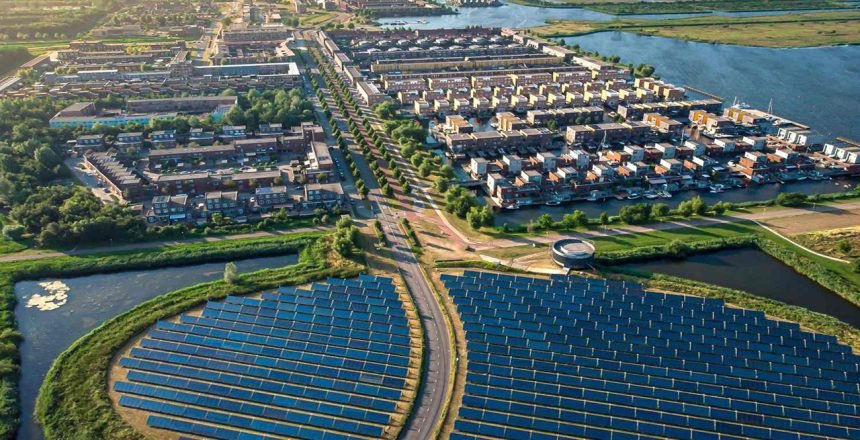
Until recently, community energy initiatives and projects focused on collective ownership of electricity generation assets, joint energy purchasing, energy efficiency and conservation.
With the arrival of Industry 4.0 technologies to the Electricity Industry, the development of virtual power plants (“VPPs”) has become possible, which have changed the way the electricity grid interacts with renewable and distributed energy resources.
A virtual power plant, or VPP, is a portfolio of heterogeneous and distributed energy resources (e.g., distributed generation, energy storage systems, electric vehicles, flexible consumers) connected to the electrical grid that operate as a single visible and coordinated entity in the energy system.
Through information and communication technologies (ICT), “Cloud Computing” and tools of “Big Data”, “Blockchain”, Artificial Intelligence and Advanced Analytics, the VPP intelligently optimizes the energy generated and consumed within the network by each individual unit, making energy storage or exchange decisions, thus creating a smart energy ecosystem.
Currently, VPPs have been used for more than a decade in modern electrical systems mainly to provide support services to the grid and/or to enable energy trading with wholesale and retail electricity markets.
An evolution of VPPs and microgrids, which are gaining momentum as a key driver for the energy transition, are community-based virtual power plants (cVPPs ). By integrating with VPPs, a community can manage how the energy generated within it is used and/or play an active role in the electricity market, offering services to the interconnected system and earning revenue from them.
This innovative smart ecosystem is enabling the active participation of smaller and independent users in electricity markets, facilitating the entry of “Prosumers” who, through their “Behind-the-meters (BTM)” assets , provide services to the grid, making this a monetization channel for their investments.
Additionally, cVPPs are helping to solve problems in the operation of the electrical system derived from the integration of Distributed Energy Resources, associated with quality of service, efficiency, stability and reliability, in addition to offering many other economic and environmental benefits to the community.
In the modern electric power industry, cVPPs can perform any or a combination of the following functions: Electricity Generator, Distribution Network Operator (“DSO”), Aggregator and/or Energy Services Company (“ESCo”).
- The cVPP, as a generator, participates in the wholesale and retail electricity market. This may include supplying (self-generated) energy to community members, trading self-generated energy on the wholesale energy market, and/or facilitating energy trading within the community, either through a community energy marketplace platform or through direct peer-to-peer energy trading.
- The cVPP, as a DSO, participates in balancing and transporting electricity on the local grid. In practice, this could mean that the community becomes (partially) responsible for operating and maintaining its own (micro)grid.
- The cVPP, acting as an aggregator, sells aggregated flexibility to stakeholders, such as the DSO, TSO, or balancing entities. This flexibility is used, for example, for grid stabilization and balancing, and can be provided through generation dispatch, (explicit) demand response (e.g., by automatically or manually switching appliances on and off), and/or energy storage.
- The cVPP as an ESCo is responsible for optimizing individual and/or community energy profiles (e.g., demand and supply) in relation to, for example, dynamic pricing (implicit response to demand) or the availability of locally generated and/or reusable energy.
cVPPs operate with a community logic composed of at least 6 elements that I describe below, and it is the members of the community who collectively decide which of these are relevant to their own case.
- Their needs and values . These can be financial (reducing the electricity bill), environmental (reducing emissions), social (community building), institutional (influencing energy policy) and technical (energy independence).
- Asset ownership. There are different models of community ownership, ranging from co-ownership to 100% community ownership. The most common ownership model is that of energy cooperatives, in which all members own a share of the entity.
- Decision-making. This usually depends on the ownership model adopted. In the energy cooperative model, each member has one vote, and the majority elects their representatives, who are responsible for the cooperative’s operational management.
- Involvement of all members. Every member is actively involved in community efforts. This can range from providing information to full active participation. No member is excluded.
- The community’s energy demand defines the scale of energy generation. Rather than maximizing economic benefits, community energy projects often link the scale of energy technology to their own needs and motivations, such as self-sufficiency. Furthermore, one of the main motivations for communities to create an energy initiative is to gain control over both the scale and location of renewable energy generation within their area.
- The results. These can refer to values as well as aspects of costs and risk appetite. An energy community needs to define how the results are distributed among its members.
Currently, some of the world’s largest power plants are cVPPs (community virtual power plants ). One of the most recent and well-known projects is a Tesla project in South Australia. This project currently supplies power to 4,000 homes through photovoltaic solar battery systems and Powerwall technology, with the goal of connecting up to 50,000 homes, which would make it the world’s largest community virtual power plant.
In Europe, the largest cVPP is Next-Kraftwerke, which operates a network of approximately 11,000 aggregated assets with a capacity exceeding 9,000 MW.
For your reference, here’s a link to a video that explains how cVPPs work in a very visual way: https://youtu.be/3Rt0iEJTW6s