

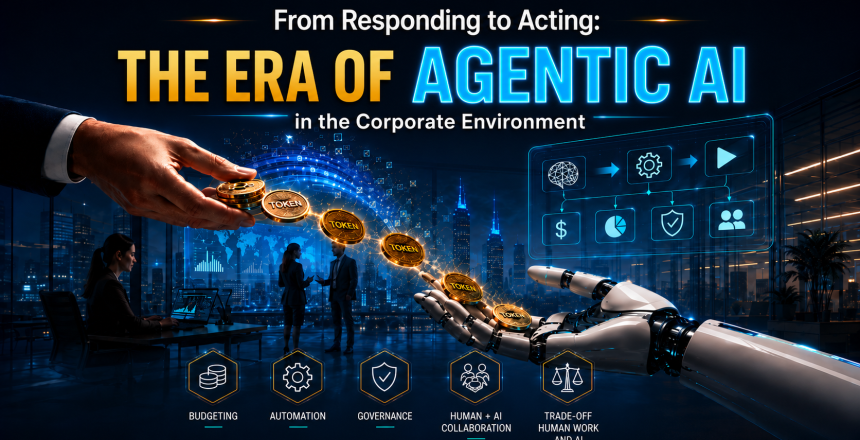
The adoption of artificial intelligence in the corporate environment has moved beyond the era of simply passively generating content and into the autonomous execution of complex processes. Projections indicate that 2026 marks the definitive turning point toward Agentic Artificial Intelligence (Agentic AI), with 40% of enterprise applications incorporating these systems by the end of the year.
According to Gartner, spending on AI agent software could reach $206.5 billion by 2026 and continue to grow strongly in the coming years, reflecting the rapid enterprise adoption of agent solutions.
Unlike traditional virtual assistants that require constant guidance, AI agents have the ability to understand a complex objective, plan logical sequences of action, invoke external tools, and dynamically correct their course until the mission is complete. The final product is no longer just text, but an operational result.
In this edition, we analyze how artificial intelligence agents are changing the way we work, how companies are organized, and how value is created. We also review their main uses, risks, and strategic implications to help leaders understand this new era and better prepare to leverage it.
Generative AI vs. Agent AI: From Responding to Acting
Agent AI represents a natural evolution of generative AI. While the former responds to a request, the latter can interpret a goal, plan a sequence of actions, use external tools, consult information, make intermediate decisions, and adjust its path until it completes a task.
In simple terms, generative AI produces answers; agentic AI seeks to achieve results autonomously. A chatbot responds within a limited script; a copilot helps the user produce or analyze information; agentic AI can plan a logical sequence of actions, connect with external tools (such as databases, emails, Teams chats, enterprise APIs, or web browsers), maintain context over time, observe the results of its own actions, and adjust its path until it completes the assigned task.

For example, given the instruction “prepare a response for this customer,” a generative model might draft a well-structured email. An AI agent, on the other hand, could review the customer’s history, identify the problem, check the order status, draft the response, update the CRM, escalate the case if necessary, and keep a record of the action taken.
The difference lies not only in technological sophistication but also in the level of operational autonomy. Generative AI functions as an assistant that amplifies human capabilities. Agentic AI functions as a system capable of executing entire parts of a process under certain defined objectives, rules, and limits.
This does not mean that AI agents replace generative AI. On the contrary, they build upon it. Language generation, reasoning, context interpretation, and synthesis capabilities remain essential components. What changes is that these capabilities are integrated within an action cycle: observe, plan, execute, verify, and correct.
While a co-pilot can suggest a response to an upset customer, an AI agent can go further: reviewing the customer’s purchase history, consulting the return policy in the ERP, approving the refund if it meets the criteria, updating the ticket in the CRM, and sending the final notification—all autonomously.
That’s why the business conversation about artificial intelligence is changing. It’s no longer just about asking what content AI can produce, but what processes it can transform, what decisions it can accelerate, and what tasks it can reliably perform.
Generative AI taught us to interact with machines that respond. Agentic AI introduces us to systems that act.
Transformation of Professional Tasks and Roles
According to AIMultiple , a research and analysis platform specializing in artificial intelligence and enterprise software, AI agents will have a particularly significant impact on entry-level, administrative, or “white-collar” roles, characterized by high volumes of structured information processing.
Recent assessments indicate that occupations such as customer service representatives, accountants, paralegals, and software developers have levels of direct exposure to AI close to 90%.

Faced with the advance of agentic AI, the workforce is beginning to reorganize itself into three main categories:
- Augmented Jobs: These are roles centered on strategic judgment, human empathy, complex negotiation, and ambiguous creativity, which will see their scope massively expanded. For a director or C-level executive, this means having agents capable of taking on much of the preparatory and analytical work: gathering information, monitoring critical variables, analyzing scenarios, reviewing documents, preparing executive reports, tracking key initiatives, and identifying emerging risks or opportunities. In this new model, the agents augment the leader’s management capacity, while the executive focuses their time on interpreting the context, defining priorities, mobilizing teams, influencing strategic decisions, and assuming ultimate responsibility for the results.
- Partially Automated (Redesigned) Jobs: These are operational roles, first- and second-level technical support, document processing, and repetitive administrative tasks, where a significant portion of the workload can be handled by AI agents. In these cases, the human role doesn’t necessarily disappear, but its nature changes: people stop performing routine tasks manually and instead act as exception handlers, quality supervisors, and those responsible for intervening when the system encounters ambiguities, errors, critical decisions, or unforeseen scenarios.
- New Capabilities and Roles: The expansion of agentic AI will also lead to new roles dedicated to designing, coordinating, monitoring, and governing this ecosystem. Roles such as workflow orchestrator, AI governance architect, and algorithmic trust auditor will become increasingly critical. Professionals who combine expertise in a specific domain, such as finance, legal, operations, technology, or risk management, with advanced AI skills will be better positioned to capture value in this new environment.
Some estimates already project salary bonuses of up to 56% for those who manage to combine artificial intelligence with in-depth business knowledge. In this new context, agentic technology redefines the role of the worker: they move from operating systems to managing intelligent systems.
Human Skills That Will Gain Relevance
The orchestration of complex cognitive systems demands a repertoire of profoundly human skills, which language models cannot yet reliably emulate:
- Systems Thinking: This involves understanding the non-linear impact of decisions. An orchestrator must be able to visualize how an instruction given to one agent can automatically affect linked agents. It’s about seeing the entire ecosystem, not just the isolated task.
- Calibrated Delegation: The ability to precisely discern what level of autonomy to grant a model. This implies understanding that a system with high average accuracy can systematically fail in marginalized subgroups or edge cases. Humans define the precise limit where algorithmic risk outweighs efficiency gains, imposing mandatory reviews.
- Critical Output Interpretation: Automation inevitably generates a “deference bias” (the human tendency to blindly trust complex computational results). Future analytical skills will focus on the ability to audit the agent’s reasoning, detect subtle hallucinations, question erroneous logical inferences, and understand the parameters under which the model was optimized.
- Governance Design: Establishing operational rules will become a core management competency. Leaders will need to define security thresholds, audit mechanisms, escalation criteria, ethical responsibilities, and traceability controls before allowing an AI agent to operate in a production environment. Governance will no longer be an afterthought, but a design requirement.
- Adaptive Leadership and Empathy: As routine work becomes automated, leadership will increasingly focus on human dynamics. Leaders will need to manage anxiety about technological displacement, create psychological safety for innovation, and inspire teams working ever more closely with intelligent systems. The challenge is not just adopting technology, but supporting people through the transition.
Corporate training programs, which have historically focused on teaching the use of specific software or narrowly defined technical skills, are facing total disruption. Training will need to rapidly shift towards abstract problem-solving, data literacy, algorithmic ethics, and AI-first process design .
New Organizational Models: The Agent Company
The 20th-century organizational design, characterized by functional silos (marketing, finance, human resources), pyramidal reporting hierarchies, and cascading manual processes, is ineffective in the era of agentic AI. Agile organizations are evolving toward a model called “The Agentic Organization,” where humans and virtual agents act as interconnected colleagues.

In the future, companies will have multiple Artificial Intelligence Agents collaborating in different parts of the organizational chart, boosting the operation and results of the entire team.
This profound change requires rethinking the organization around five fundamental pillars:
- Business model: AI is no longer just a tool for reducing costs; it’s becoming a source of competitive advantage. It allows for the creation of more personalized products and services, better customer service, and the development of new revenue streams.
- Operating model: Instead of embedding AI agents within inefficient human processes, the operating model is redesigned using an AI-first approach . End-to-end processes are structured assuming that artificial intelligence will handle routing, routine decision-making, and system execution, elevating humans “above the loop” to validate exceptions and set goals. In this model, people focus more on defining objectives, monitoring results, and resolving exceptions.
- Integrated governance: Oversight cannot only occur at the end of the process. Organizations need real-time controls, metrics, and alerts to ensure that decisions made by AI agents are traceable, secure, and aligned with business rules.
- Talent, people, and culture: Agent AI is changing the way we work. Teams will need to learn to collaborate with AI agents as new digital partners. This institutionalizes hybrid collaboration between humans and agents (“AI coworkers”). This requires new skills: knowing how to give instructions, monitor results, validate decisions, and continuously improve systems.
- Technology and data: For agents to function effectively, they need access to reliable, connected, and real-time data. If information is scattered across silos, AI will be unable to produce good results. Therefore, an integrated database and a single source of truth become essential for any organization that wants to move toward an agentic model.
Financial Economics of Agent AI
Agent AI introduces a new economic reality for organizations: digital work no longer depends solely on licenses, infrastructure, or human salaries, but also on the continuous consumption of tokens. Every instruction, query, analysis, summary, search, iteration, validation, and response generated by an agent has an associated computational cost.
In traditional generative AI, token consumption is usually relatively controlled: the user asks a question, the model responds, and the interaction ends. In agentic AI, the dynamics change radically. An agent doesn’t just respond; it plans, queries information, calls tools, compares alternatives, corrects errors, retries tasks, generates reports, reviews documents, maintains context, and coordinates multiple steps to complete a goal. This can cause token consumption to increase exponentially.
A seemingly simple task, such as “preparing an executive report on the month’s sales performance,” can involve multiple internal cycles: reading databases, reviewing emails, consulting documents, analyzing deviations, generating hypotheses, preparing charts, drafting conclusions, validating consistency, and producing a final version. Each of these steps consumes tokens. If several specialized agents are involved—one in finance, one in sales, one in legal, one in risk, and one in executive synthesis—the cost multiplies.
Therefore, in the era of agentic AI, tokens become a new economic unit of labor.
Organizations will need to learn to manage tokens the way they currently manage man-hours, consulting budgets, software licenses, cloud consumption, or operating expenses. The question will no longer be simply how much an AI tool costs, but how much it costs to operate entire processes with intelligent agents at scale.
This change necessitates the introduction of a new management discipline: the artificial intelligence budget by area, process, and use case.
Each department must understand its consumption pattern. Finance can use tokens for budget analysis, reconciliations, management reports, and scenario modeling. Legal can use them for reviewing contracts, identifying risks, and preparing responses. Human Resources can use them for training, profile assessments, and document management. Sales can use them for proposals, customer analysis, pricing, and opportunity tracking. Risk can use them for exposure monitoring, early warnings, counterparty analysis, and preparing executive reports.
In this new model, each area will have to justify not only its personnel or systems budgets, but also its cognitive automation budget.
The financial management of agentic AI will need to answer very specific questions:
- How many tokens does this process consume per execution?
- How many times is it run per day, per week, or per month?
- How much does it cost to produce a report, respond to a case, review a contract, or analyze a client?
- What portion of the consumption corresponds to high-value tasks and what portion to unnecessary iterations?
- Which agents are generating the highest costs?
- Which areas are consuming the most tokens?
- Is digital cost replacing, complementing, or duplicating human labor?
- Does the value generated justify the consumption?
This point is critical. Agent AI can create enormous efficiencies, but it can also introduce a new form of invisible spending. If agents operate without limits, monitoring, or clear value criteria, token consumption can grow uncontrollably. The organization could end up paying for thousands of interactions, intermediate reasoning, redundant queries, and automated processes that don’t necessarily generate proportional value.
The risk is not just technological. It’s financial.
Therefore, the governance of agentic AI must include budgetary control mechanisms. Companies will need consumption dashboards by business unit, limits by agent type, monthly budgets by area, overuse alerts, cost metrics per task, and clear criteria for deciding when to use more powerful models and when to use simpler or specialized models.
Not all tasks require the most advanced model. Not all decisions justify a complex chain of agents. Not all analysis needs to process thousands of pages or maintain complete context. Part of the efficiency will come from learning to use the right intelligence for each type of work.
In this sense, token optimization will become a new organizational and leadership competency. Companies will need to design more efficient prompts, reduce redundant instructions, limit unnecessary context, reuse structured knowledge, create well-organized corporate memories, use smaller models for repetitive tasks, and reserve the most expensive models for higher-impact decisions.
The economics of agentic AI is not just about automation. It’s about automation with financial discipline.
The most relevant analysis will be the trade-off between the cost of agents and the cost of human labor. However, this comparison should not be simplistic. It is not enough to say that an agent costs less than an employee. The correct comparison must consider productivity, quality, speed, supervision, risk, scalability, and value generated.
A human worker has a fixed salary, benefits, limited time, and finite capacity. An AI agent can operate continuously, scale rapidly, and perform multiple tasks in parallel, but its variable cost can increase with each interaction, document processed, tool consulted, or iteration performed. In other words, the human primarily represents a fixed cost; the agent introduces a combination of fixed technological costs and variable usage costs. This changes the decision-making logic.
- For repetitive, high-volume, well-structured, and low-risk tasks, an agent can be financially superior. It can execute tasks faster, at a lower marginal cost, and with greater consistency. In these cases, a comparison against human wages usually favors automation, especially when the process is executed thousands of times.
- However, for ambiguous, strategic, sensitive, or high-responsibility tasks, the cost of an agent cannot be evaluated solely in terms of tokens consumed. The costs of human oversight, validation, potential errors, reputational risk, regulatory compliance, and ultimate liability must be considered. In these cases, the agent can be a productivity-enhancing tool, not necessarily a complete replacement.
The real value will not lie in automatically replacing people, but in redesigning the combination of humans and agents. The right question will not be, “How many people can this agent replace?” but rather, “What part of the work can an agent perform, what part should a person supervise, and what new organizational capabilities are enabled by this combination?”
In many cases, the return will come not from reducing staff, but from increasing the organization’s capacity without proportionally growing its structure. A finance team will be able to analyze more scenarios. A legal team will be able to review more contracts. A sales department will be able to prepare more proposals. A risk team will be able to monitor more variables. An executive will be able to receive better input to make faster decisions.
That will be the real economic leverage: more capacity, more speed and better quality without linearly increasing the number of people.
To achieve this, organizations will need to move from isolated experimentation to a formal model for the financial management of AI. This involves cost centers, consumption metrics, approval managers, prioritization criteria, and regular reviews of the value captured.
The future of work will not only have organizational charts of people. It will also have budgets for agents.
The competitive advantage will not lie in consuming more artificial intelligence, but in consuming it better. The challenge will be to build an architecture where each token has a business rationale, each agent has a clear purpose, and every dollar invested in AI can be compared to the value it generates.
Conclusion
Agent AI is ushering in a new era of business transformation. It’s no longer just about using tools that can answer questions or generate content, but about incorporating systems that can act, coordinate tasks, query information, execute processes, and learn from their own results within defined boundaries.
This evolution promises enormous gains in productivity, speed, and organizational capacity. However, it also introduces a new financial reality: artificial intelligence is neither free nor unlimited. Every interaction, every query, every processed document, every iteration, and every assisted decision consumes tokens. And as agents are integrated into more processes, areas, and decision-making levels, this consumption could become a significant item in the corporate budget.
Therefore, the real challenge for companies will not simply be adopting AI agents, but learning to manage them with strategic, operational, and financial discipline. Organizations will need to understand which agents generate value, which processes justify automation, which tasks require human oversight, and how the cost of digital work compares to the cost of human work.
The future of work will not be a simple replacement of people with machines. It will be a profound reconfiguration of how human talent, intelligent agents, data, processes, and budgets are combined. In some cases, agents will replace repetitive tasks; in others, they will expand the capacity of teams; and in the most strategic cases, they will serve as advanced copilots to improve the quality and speed of decisions.
The competitive advantage will not lie in consuming more artificial intelligence, but in consuming it better. Every token must have a business rationale. Every agent must have a clear purpose. Every dollar invested in AI must be comparable to the value it generates.
Companies that achieve this balance will be able to transform agentic AI into a genuine source of productivity, innovation, and competitive advantage. Those that fail to do so risk replacing human inefficiencies with new digital ones.
Ultimately, the key question for leaders will not be whether to adopt AI agents, but whether they are prepared to redesign their organization, their talent, and their budgets around a new way of working: one where humans and intelligent agents collaborate to produce better results.
References
Enterprise AI Agents Adoption Statistics 2026 – Paul Okhrem, https://paul-okhrem.com/enterprise-ai-agents-statistics-2026/
What Is Agentic AI? The 2026 Guide – TinyCommand, https://tinycommand.com/ai-agents/what-is-agentic-ai
Agents vs. Chatbots vs. Copilots: How to Choose the Best AI Tool – Deel, https://www.deel.com/blog/agents-vs-copilots-vs-chatbots/
The Agentic Organization: Contours of The Next Paradigm for The AI Era | McKinsey, https://www.brianheger.com/the-agentic-organization-contours-of-the-next-paradigm-for-the-ai-era-mckinsey/
The agentic organization: A new operating model for AI | McKinsey, https://www.mckinsey.com/capabilities/people-and-organizational-performance/our-insights/the-agentic-organization-contours-of-the-next-paradigm-for-the-ai-era
Orchestration: The New Management Skill for 2026 – SocialLab, https://sociallab.ai/ai-orchestration-new-management-skill-2026/
Leading in the Age of AI Agents: Managing the Machines That Manage Themselves, https://www.bcg.com/publications/2025/machines-that-manage-themselves
Accountability by design in the agentic organization | McKinsey & Company, https://www.mckinsey.com/capabilities/people-and-organizational-performance/our-insights/the-organization-blog/accountability-by-design-in-the-agentic-organization