

When talking about Data Centers, we cannot avoid worrying about the electricity and water consumption that these facilities demand to support the advancement of Artificial Intelligence (AI), high-performance computing, and the deployment of hyperscale infrastructure.
And it’s a valid concern. Because behind every AI model, every generative query, every stored video, every digital transaction, and every automated process, there’s a physical infrastructure that consumes energy, generates heat, and needs to be continuously cooled.
Every GPU, every CPU, every power supply, every memory module, and every piece of network equipment converts electrical energy into computational work, but also into waste heat. The more intense the computing load, the greater the energy consumed and the greater the heat load that must be removed.
A decade ago, many computer cabinets or racks operated in power consumption ranges of 5 to 15 kW. Today, racks with GPUs for artificial intelligence can exceed 50, 100, and even 200 kW in next-generation configurations.
This means that a single modern AI rack, occupying approximately 0.7 m², can concentrate an electrical demand similar to that of dozens of homes operating simultaneously. Furthermore, virtually all of that energy must leave the rack as heat, concentrating in that small space the thermal equivalent of dozens of electric ovens operating at the same time.
And if that heat isn’t removed quickly and accurately enough, the problem isn’t just temperature. It’s performance.
When chips reach certain thermal limits, they automatically reduce their processing capacity to protect themselves. This is known as thermal throttling . In practice, the data center can remain powered on, but it delivers less usable computing power.
This reality means that conventional air cooling, which for decades was the dominant solution in the industry, is becoming insufficient as a sole response to new AI workloads. Therefore, data centers are accelerating the adoption of liquid cooling technologies in various forms: from direct-to-chip solutions to immersion systems.
The challenge is significant. Cooling systems can account for up to 50% of a data center’s total electricity consumption. Therefore, reducing that percentage, or at least keeping it under control as computing density continues to grow, has become a strategic imperative for operators, investors, and regulators.
Then legitimate questions arise:
Will our cities run out of electricity? Will data centers consume or pollute the water in our communities? Can digital infrastructure grow without creating new environmental and social tensions?
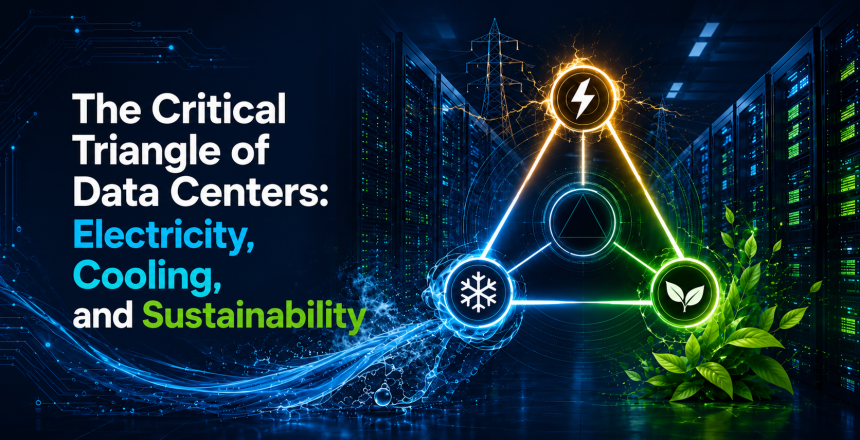
To understand this reality without myths or alarmism, we need to look at the issue from what we could call the critical triangle of data centers : three completely connected vertices that define how this technology of the future is being built responsibly.
Electricity. Cooling. Sustainability.
1. Electricity: the first vertex of the triangle
The first obvious challenge is energy. Artificial intelligence computers need a lot of electricity to process millions of data points in seconds and sustain increasingly intensive workloads.
According to the International Energy Agency (IEA), global data center energy consumption is projected to triple by 2030. This is because new chips from brands like NVIDIA and AMD are incredibly powerful.
How are we addressing the issue to avoid overloading our cities’ networks?
The operators of these centers know that traditional power grids in most of our countries are already heavily congested and that permits to connect can take years. That’s why the industry is moving away from relying on public power lines.
The new trend is clean, on-site self-generation: companies are building their own clean energy sources (such as solar farms, wind turbines, or massive battery storage systems) right next to their data centers. Globally, contracts are even being signed to use small advanced nuclear reactors (SMRs) dedicated exclusively to these facilities, guaranteeing a constant energy supply without disrupting electricity service for the general public.
2. Cooling: the second vertex
If you’ve ever used a laptop for a demanding task or a video game, you’ve probably noticed it gets hot and a small fan starts whirring. Now multiply that by thousands or millions of processors concentrated in a single installation. The heat generated is immense and poses a thermal challenge on an industrial scale.
Historically, many data centers were cooled similarly to a highly air-conditioned building: large air conditioning systems blew cool air onto the equipment and extracted hot air from the room. This worked for decades, when data densities were lower. But with artificial intelligence, this model is beginning to encounter physical limitations.
Air has a much lower heat transfer capacity than water per unit volume. At extreme densities, trying to achieve this solely with air can significantly increase auxiliary energy consumption, raise noise levels, reduce efficiency, and push equipment towards thermal limits that negatively impact performance. Therefore, the industry is migrating towards hybrid and liquid cooling solutions.
There is no single winning technology for all situations. The right solution depends on the climate, rack density, water availability, energy costs, the age of the facility, the criticality of the loads, and local regulations.

2.1 Traditional Air Cooling (CRAC/CRAH)
For decades, CRAC (Computer Room Air Conditioning) and CRAH (Computer Room Air Handler) systems were the backbone of every data center in the world. Air conditioning units cooled the air in the cold aisle, that air circulated through the servers, absorbed the heat, and returned warm to the back aisle to dissipate.
It’s mature technology, with established vendor ecosystems, abundant skilled personnel, and low initial costs. In installations with densities of 5 to 15 kW per rack—the standard for most of data center history—it worked perfectly well.
The problem is that their physical power ceiling is around 30-40 kW per rack under sustained conditions, and their typical PUE (Power Usage Effectiveness)—the ratio between the building’s total power consumption and the consumption of the computing equipment—ranges from 1.5 to 2.0. This means that for every kilowatt a server uses, the cooling system consumes another kilowatt just to keep it cool. For modern AI workloads, air cooling is no longer sufficient as a sole solution. At these levels, physics dictates that hybrid or liquid cooling architectures are necessary.
2.2 Chilled Water Systems
A step above pure air, chilled water systems introduce a circuit of cold water—typically at 7–12°C—produced by a centralized chiller and distributed to the CRAH units located in the room. Instead of relying solely on airflow, the water acts as a more efficient heat transfer medium between the server room and the outside.
This architecture is the standard in medium and large data centers due to its scalability and centralized control capabilities. It can handle densities of 15 to 30 kW per rack and achieve PUEs of 1.2 to 1.5, better than pure air but still far from ideal. Its greatest environmental cost arises when evaporative cooling towers are used to dissipate heat to the outside: water consumption can become significant, especially in arid climates.
The trend in 2025 points to combining chillers with free cooling systems to reduce the hours that the mechanical chiller needs to operate, lowering both PUE and total consumption.
2.3 Free Cooling and Energy Saving
Free cooling takes advantage of favorable environmental conditions to reduce or eliminate the need for mechanical cooling. In cold or temperate climates, it can significantly reduce the energy consumption of the cooling system. This makes it very attractive in regions of Northern Europe, parts of North America, and areas of the Southern Cone.
Apple, Google, and Microsoft use this technique extensively in their facilities in Northern Europe and the northwestern United States, where it is cold outside for more than 200 days a year. Under these conditions, the energy savings are enormous.
But its usefulness depends on the climate. In tropical regions—such as much of Central America, the Caribbean, or northern South America—the effective hours of free cooling can be much lower. This doesn’t mean it’s irrelevant, but it does mean that a model designed for Finland, Sweden, or the northwestern United States cannot be mechanically copied and applied without adjustments in Panama, Colombia, or the Dominican Republic.
2.4 Evaporative (Adiabatic) Cooling
Evaporative cooling takes advantage of a common physical phenomenon: when water evaporates, it absorbs heat from the surroundings and lowers their temperature. When applied on a large scale in air pre-cooling systems or cooling towers, it can achieve unit operating values (UPEs) of between 1.15 and 1.4 with relatively low electricity consumption. However, its environmental and social costs can be high when implemented in areas with water stress or low community acceptance.
An intensive evaporative system can consume between 2 and 5 liters of water for every kilowatt-hour of computing energy.
2.5 Rear-Door Heat Exchangers (RDHx)
RDHx is the first truly hybrid solution on this list, and also the most pragmatic for those who need to upgrade quickly without replacing their entire infrastructure. It consists of panels with chilled water coils that mount on the rear door of the rack—right where the hot air escapes—and intercept that heat before it reaches the aisle.
Their greatest advantage is compatibility: they don’t require modifying the servers, only installing the panel and connecting it to the building’s water system. This makes them the preferred option for retrofitting GPU racks in facilities originally designed for lower-density loads. They can handle between 20 and 50 kW per rack and reduce the load on the room’s HVAC system, lowering the PUE to 1.2-1.4.
Their limitation is structural: since they don’t completely eliminate room cooling, they are a complement, not a definitive solution. As densities exceed 50 kW per rack, even the most advanced RDHx systems reach their limit. The 2025 AFCOM report indicates that 29% of data centers already implement them in some form, with Meta and Digital Realty among the most prominent examples.
2.6 Direct-to-Chip Liquid Cooling (DTC)
This is where truly liquid cooling solutions come into play, and DTC is currently the most widely adopted of them all. Instead of cooling the room air so that the air can then cool the chips, the liquid is delivered directly to where the heat is generated: a metal cold plate in direct contact with the processor or GPU. The fluid—usually water or a water-glycol mixture—absorbs the heat from the chip and carries it out of the rack to a coolant distribution unit (CDU).
The leap in efficiency is dramatic. The PUE drops to 1.05-1.2, close to the theoretical ideal. Water consumption is low because the system operates in a closed loop: the liquid doesn’t evaporate, it’s simply recirculated and cooled in an external heat exchanger. And the supported load capacity increases to 30-100 kW per rack, with next-generation designs targeting 200 kW.
Compatibility with the AI ecosystem is high and growing. NVIDIA offers reference designs with integrated cold plates for its HGX H100, H200, and Blackwell systems. Major server manufacturers—Supermicro, Dell, HP Enterprise—sell DTC versions of their GPU racks. Microsoft began mass deployment of this technology across its server fleet in July 2025. Next-generation cold plates, such as those from Accelsius and CoolIT, can handle heat flows of up to 300 W/cm²; Frore Systems has demonstrated 600 W/cm² in areas of high thermal concentration.
It is no coincidence that DTC currently holds 47% of the liquid cooling market and is projected to be the fastest-growing technology in 2025-2026. It is the most accessible bridge between the world of air cooling and the future of total liquid cooling.
2.7 Single-Phase Immersion Cooling
While DTC delivers liquid to the chip, immersion takes a more radical step: it submerges the entire server in a tank of non-conductive dielectric fluid—synthetic oils, plant-based fluids—that envelops all components simultaneously. The fluid absorbs heat from the entire board, circulates to an external heat exchanger, and returns to the tank. There is no evaporation; no phase change; the fluid remains liquid at all times.
In optimized designs, it can achieve very low PUEs, ranging from 1.03 to 1.1, with very low operating water consumption. The servers operate at lower and more stable temperatures, significantly extending their lifespan. Waste heat can be recovered at temperatures of 40-50°C, sufficient for heating buildings or other industrial processes.
Its disadvantages are cost and complexity: specialized tanks, dielectric fluids, and associated infrastructure imply high capital expenditure. Accessing servers for maintenance requires extracting them from the fluid, which demands specific procedures and training. Even so, adoption is progressing. Submer—one of the industry leaders—signed an agreement in 2025 with the government of the state of Madhya Pradesh in India to develop up to 1 GW of single-phase immersion-based AI data centers.
2.8 Two-Phase Immersion Cooling
Two-phase immersion takes physics a step further. Instead of a fluid that simply absorbs heat while remaining liquid, special fluids—fluorocarbons, hydrofluoroolefins—with very low boiling points, between 49 and 60°C, are used. When the component’s temperature exceeds this threshold, the fluid evaporates directly onto the chip, absorbing a huge amount of heat in the phase change process. It then rises as vapor to the heat exchanger at the top of the tank, condenses back into a liquid, and falls back down by gravity. The cycle repeats without pumps in the primary circuit.
It can be one of the most efficient systems: PUEs of 1.02 to 1.06, very low water consumption, and very high thermal capacities under optimal conditions. In theory, it is the ideal solution for the densest racks on the planet.
In practice, it faces significant obstacles. The fluids are expensive, and several of the fluorocarbons historically used are subject to regulatory restrictions in Europe due to their high global warming potential (GWP). They require very extensive greenfield designs or retrofits. Their commercial maturity is moderate, and the ecosystem of suppliers and trained personnel is still small. For now, their adoption is concentrated in extreme supercomputing, research, and some high-performance cryptocurrency mining operations.
2.9 Microfluidic Cooling: The New Frontier
At the most advanced end of the spectrum, the question is no longer how to get the liquid to the chip, but how to get it inside the chip. Microfluidic cooling etches microchannels directly into the silicon substrate or adjacent structures, pushing coolant through conduits the thickness of a human hair to dissipate it precisely where the heat is generated: at the transistor level.
Companies like Corintis are developing these biologically inspired systems—the channels resemble the veins of a butterfly—and TSMC, NVIDIA, Microsoft, and HP are actively researching next-generation embedded cooling variants. Their potential is very high and could be relevant for the next generation of AI chips.
Although it is not yet commercially available on a large scale, its strategic importance is difficult to overstate: it could become a key enabler for future generations of chips with increasingly demanding thermal densities.
III. Sustainability: the vertex that defines the social license
Sustainability is probably the most sensitive point of the triangle, because it connects digital infrastructure with two resources that communities understand very well: electricity and water.
One of the most significant challenges in selecting power and cooling technologies for data centers is the often inverse relationship between energy efficiency and water consumption. Traditionally, energy efficiency has been measured using PUE ( Power Usage Effectiveness ), while water impact is assessed using WUE ( Water Usage Effectiveness ). Therefore, the Uptime Institute has promoted the combined use of both metrics as a more comprehensive way to evaluate data center performance.
Adding to this discussion is the concept of Power Compute Effectiveness (PCE) , championed by Schneider Electric and other industry players, which aims to measure how much useful computing power is obtained for each unit of energy consumed. This metric is particularly relevant for artificial intelligence workloads, where computational performance—for example, inference throughput —is as important as energy consumption.
A 100 MW AI data center with evaporative cooling can consume between 1.5 and 3.0 million m³ of water per year. A closed-loop DTC or immersion cooling system can reduce this consumption by more than 90%, without sacrificing energy efficiency.
This is precisely one of the points where there are the most misunderstandings and urban myths.
It is true that, in the past, some traditional data centers generated significant water impacts and social tensions in various markets, including cases in Latin America such as Chile and Uruguay. Some of these designs relied on evaporative cooling, a technology that can require the evaporation of large volumes of water to dissipate heat. Faced with this reality, communities, authorities, and environmental courts reacted strongly, halting projects, demanding redesigns, and raising the standard for environmental assessments.
Thanks to that social pressure, and also to the evolution of engineering, today it is possible to analyze the issue of water with greater technical precision and less alarmism.
Myth 1: Data centers will dry up our rivers and drinking water networks
The reality: New liquid cooling technologies use closed circuits (closed loops). This means that the water or coolant circulates inside completely sealed pipes. The liquid does not evaporate continuously; it is recirculated within the system and only requires occasional top-ups for maintenance or minor leaks.
To cool the hot liquid returning from computers, external radiators called dry coolers can be used. These transfer heat to the environment without continuously evaporating water. With this design, the operating water consumption associated with cooling can be drastically reduced and approach zero in certain configurations.
Myth 2: The chemicals they use will contaminate the local water
The reality: The risk of water or environmental contamination is strictly controlled by very stringent global regulations. In the past, experimental systems (called two-phase immersion systems) existed that used very complex synthetic chemical fluids. However, due to environmental concerns about long-lasting chemical components (so-called PFAS), the world’s leading chemical companies (such as 3M) stopped manufacturing them completely by the end of 2025.
As a result, data center operators completely abandoned those technologies with chemical risks. Today, closed-loop systems use only deionized water mixed with common glycol (a standard antifreeze identical to that used in any family car’s radiator) or safe, biodegradable dielectric oils of synthetic or vegetable origin. Because these are hermetically sealed systems that do not generate liquid discharges to the outside, the possibility of contaminating local water networks is virtually nil.
Conclusion
Concern about sustainability in the digital age is entirely legitimate, but current technology already provides the tools to address it. Governments around the world are becoming increasingly strict: the European Union will require data centers to publicly display sustainability labels (like those on household appliances) and comply with very rigorous efficiency limits starting in 2027.
For rapidly growing regions like Latin America, the key is not to close the door on Artificial Intelligence, but to demand that it be built according to the rules of 2026, not those of the past. If we demand from day one architectures that are low in water consumption, provide clean and reliable energy, ensure transparency in metrics such as PUE, WUE, and PCE, and guarantee responsible integration with electrical grids, our countries will be able to attract massive technological investments, develop local technical capabilities, and participate in the economy of the future while better protecting their most valuable natural resources.
References
Data Center Outlook 2026: Power and Cooling Challenges and Solutions Are Top of Min https://www.coresite.com/blog/data-center-outlook-2026-power-and-cooling-challenges-and-solutions-are-top-of-mind
The State of the Data Center 2026 https://datacenterrichness.substack.com/p/the-state-of-the-data-center-2026
Uptime Institute Global Data Center Survey 2024 https://datacenter.uptimeinstitute.com/rs/711-RIA-145/images/2024.GlobalDataCenterSurvey.Report.pdf
Data center policies in the EU https://www.danfoss.com/en/industries/buildings-commercial/shared/data-centers/data-center-policies-in-the-eu/
Data centers’ cooling needs are largely unmet: AFCOM https://www.facilitiesdive.com/news/afcom-data-center-world-report-energy-demand-security-technology/708254/
Direct-to-Chip Cooling – Dober https://www.dober.com/direct-to-chip-cooling
How to use water wisely in data centres – Ramboll https://www.ramboll.com/insights/decarbonise-for-net-zero/how-to-use-water-wisely-in-data-centres
How rear door heat exchangers (RDHx) support high-density rack cooling – Vertiv https://www.vertiv.com/en-asia/about/news-and-events/articles/educational-articles/how-rear-door-heat-exchangers-rdhx-support-high-density-rack-cooling/
EU Data Centers and Energy Policy: Sustainability Rules, Power Demand, and What Comes Next | ThinkSet | BRG https://www.thinkbrg.com/thinkset/eu-data-centers-and-energy-policy-sustainability-rules-power-demand-and-what-comes-next/
2025 Best Practice Guidelines for the EU Code of Conduct on Data Centre Energy Efficiency https://publications.jrc.ec.europa.eu/repository/handle/JRC141521
Latin America Data Center Boom Needs Infrastructure – Latinvex https://latinvex.com/latin-america-data-center-boom-needs-infrastructure/
Report: Data Centers & Sustainable Energy in Latin America https://iamericas.org/report-data-centers-energy-sustainability-latin-america/
The human cost of the data center push in Latin America – Global Voices https://globalvoices.org/2026/04/29/the-human-cost-of-the-data-center-push-in-latin-america/