

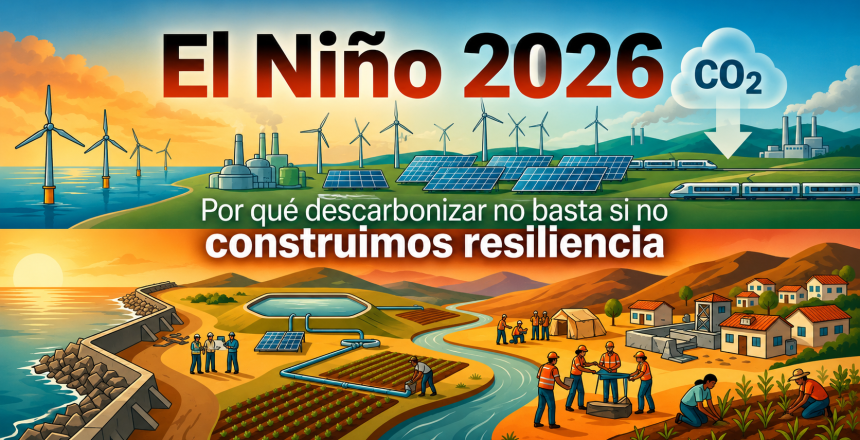
In the coming months, the climate will once again put Latin America to the test. Major international climate centers agree on one key point: the El Niño phenomenon has a high probability of developing during the second half of 2026 .
And although this may sound far off, its impacts are already being felt .
What’s happening with El Niño?
- The global climate system is emerging from a weak La Niña and moving towards neutral conditions .
- The probability of El Niño occurring between June and August exceeds 60–70% , according to various international organizations.
- There is even a significant possibility that it will be a strong event towards the end of the year , although the exact intensity remains uncertain.
Model forecasts reveal likelihood of ‘super El Niño’ that could push temperatures to the extreme
Meanwhile, on the South American Pacific coast, a preview is already being experienced:
The Coastal Niño , with an anomalous warming in the Niño 1+2 region of the ocean off Ecuador and Peru, which since February 2026 has generated severe impacts.
The Coastal El Niño impacts Peru: 52% of municipalities in a state of emergency
The Blind Spot of the Latin American Energy System
Latin America has one of the cleanest electricity grids in the world , but also one of the most vulnerable to climate change . This is because it relies excessively on a single source: hydroelectricity .
- The region has enormous hydroelectric potential, but:
- Much of the generation is concentrated in large reservoirs .
- When there is less rain for extended periods, national energy systems become stressed .
In 2026, El Niño will bring droughts to the north (Colombia, Venezuela, and Central America) and extreme rainfall to the south (Peru, Ecuador, and Chile). These rains threaten to damage electrical and road infrastructure, jeopardizing the region’s energy supply.
The result:
- Risk of rationing
- High prices
- Emergency decisions
As we move towards a cleaner energy mix, the imminent development of the El Niño phenomenon in 2026 forces us to recognize something key: adding renewable installed capacity is not enough if the system lacks:
- Firm energy
- Actual thermal availability
- Logistics and fuel contracts
- Flexibility
- Financial/regulatory coverage
- and above all, infrastructure prepared to withstand extreme events like this.
https://lac.iom.int/es/blogs/el-impacto-de-el-nino-y-la-nina-en-america-latina-y-el-caribe
In countries like Ecuador, where hydroelectricity represents 69% of the national capacity, the rainfall this year has already caused vital reservoirs like Mazar to lose up to 11 meters of water level in a single month.
The lack of efficient thermal backup has left the country in a position of extreme vulnerability , forcing it to resort to costly temporary solutions such as renting barges and imported diesel.
Implications for the Energy Industry
What happens when the water fails?
During dry periods:
- The use of thermal power plants (natural gas, coal, diesel) is increasing.
- If these plants are unavailable, or fuel is expensive or scarce: prices skyrocket, reliability drops, and the risk of blackouts increases.
Thermal energy is a backup insurance , but it only works if:
- There is real capacity
- There are fuel contracts and logistics in place.
- The system can absorb the cost
The situation in Colombia during 2015-2016 is particularly illustrative ( El Niño Colombia 2015-2016 case) . During that period, the system experienced a decrease in reservoir levels and an increase in thermal power dispatch, sharp increases in spot prices (US$400/MWh), and vulnerabilities due to insufficient coverage.
How do non-conventional renewables such as solar and wind power contribute?
They are essential for decarbonization, but they are not immune to the climate .
The ENSO phenomenon can:
- alter wind patterns,
- change the effective solar radiation,
- generate complementarities… or tensions.
The key to resilience lies not in relying on a single technology, but in structuring diversified portfolios that integrate zero- or low-emission sources with a synergistic approach . In this regard, this study by the Inter-American Development Bank underscores that assessing this complementarity is vital to strengthening energy security in the face of climate shocks such as El Niño.
And what about the physical risk to the infrastructure?
The impact of El Niño is not just how much energy is produced, but whether it can reach the consumer .
Where flooding/landslide risk is dominant (e.g., eastern Pacific coast), the main impact may not be the available energy, but the ability to transport and restore the energy supply : tower collapse, scour, substation failures, and prolonged losses if access is blocked.
A clear example is the ENFEN report in Peru, which anticipates an increase in the severity of floods and the activation of ravines. These events constitute critical risks to the integrity of physical assets and the operability of the system.
Strategic Priorities for the Short and Medium Term
The possible development of the El Niño phenomenon towards the end of 2026 not only represents a climate risk, but also a direct test of the operational, regulatory and financial resilience of our electrical systems in Latin America.
It is crucial that industry leaders react promptly, before the margin for maneuver is exhausted. We must move beyond reactive measures and focus on capabilities that do not compromise reliability, cost-effectiveness, or the economic dynamism of our countries.
Below, I share some strategic actions that I consider priorities and that we must begin to address immediately:
Short Term (0–6 months): Containment and operational readiness
- Activate El Niño action plans based on probabilities , coordinating information on rainfall and flows, operation of the electrical system, availability of fuels and risks to infrastructure, with clear alerts that are activated when certain indicators reach critical levels (for example, high probability of El Niño >60% in JJA; or low water levels in reservoirs <2 months).
- Re-optimize reservoir operating curves , aligning firm energy criteria (e.g., minimum >2 months) by integrating a multi-purpose approach to water management.
- Ensuring real thermal availability involves reviewing preventive maintenance and prioritizing critical units to guarantee availability during periods of peak hydrological stress; monitoring critical inventories and firm fuel contracts with redundant logistics, minimizing spot market purchases as much as possible . It is also crucial to simulate unavailability scenarios to identify bottlenecks and response times, transitioning from installed capacity to reliable capacity under stress conditions.
- Strengthening price and energy hedging , including stress tests that simulate the impact of extreme price scenarios on the market, is crucial. Climate volatility cannot dictate the cost of living for citizens or the competitiveness of businesses. In this regard, intervention must be comprehensive: while companies ensure their operating liquidity, the government must activate macroeconomic hedging plans . This financial protection is the only effective tool to prevent cost spikes from becoming widespread and uncontrollable subsidies that drain the public budget and compromise the country’s fiscal sustainability.
Short-Medium Term (0-12 months): Flexibility and system management
- Implement demand management programs , especially during heat waves (time-of-use tariffs, industrial response, cooling efficiency). It’s never too late to start with these types of measures.
- Accelerate the implementation of operational flexibility mechanisms , incorporating energy storage (BESS and other technologies), robust operating reserves, and more dynamic use of regional interconnections. These interconnections should be strategically conceived as a “shared battery ,” capable of absorbing surpluses, mitigating deficits, and optimizing system operation at the regional level, improving both resilience and economic efficiency. This requires avoiding isolationist approaches when extreme events occur and beginning to operate as an energy-integrated region, where coordination and complementarity among countries are central to the solution.
- Strengthening the complementarity of hydro-solar-wind power, supported by optimized thermal dispatch: We must refine operational coordination to leverage the natural synergy among all resources. The core strategy should be to “conserve water during the day” through intensive solar generation, reserving hydroelectricity to cover nighttime peak demand and periods of low wind. This scheme must be complemented by efficient thermal dispatch that acts as a stable anchor , ensuring that backup power comes online only when strictly necessary, displacing the use of expensive fuels and protecting the strategic reserve of low-emission, low-cost fuels.
Medium Term (0–24 months): Structural resilience
- Investing in physical risk mitigation and asset hardening: It is not enough to react to failures; we must proactively protect critical infrastructure (substations, trunk lines, and logistics hubs). This involves updating risk maps for floods and landslides, reinforcing physical defenses, and integrating predictive maintenance technologies that allow us to anticipate vulnerabilities before an extreme event turns them into systemic collapses.
- Expanding and modernizing transmission networks to eliminate bottlenecks: The grid is the circulatory system of our energy. We must prioritize investments that allow us to evacuate surplus energy from areas with renewable resources to consumption centers. A robust and modernized grid is also the indispensable foundation for true regional integration , enabling interconnections to function as a mutual safety net against local deficits.
Conclusion
The potential El Niño of 2026 is not just a climatic phenomenon. It is a stress test for Latin America’s energy infrastructure. The current vulnerability, evidenced by recent crises in Ecuador and Peru, and the historical precedents of Colombia, Panama, and others, confirm that having a clean energy mix is not synonymous with having a secure one. Decarbonization is the goal, but resilience is the necessary vehicle to reach it without sacrificing economic stability.
To navigate the end of 2026 and the years to come, the region must transcend crisis management and adopt a comprehensive energy security vision based on three pillars:
- Technological Synergy: The key lies not in choosing between renewables and thermal power, but in intelligent “orchestration.” We must maximize solar and wind power generation to preserve reservoir water and use thermal backup not as a last desperate resort, but as a planned and efficient guarantee of reliability.
- Regional Integration: Electrical interconnections must move beyond mere agreements of convenience and become a shared energy system. Energy solidarity and cross-border coordination are the most cost-effective tools for mitigating local energy deficits.
- Infrastructure and Financial Protection: The physical protection of assets and the use of financial hedging mechanisms are essential. We cannot allow climate variability to translate directly into fiscal shocks or a loss of competitiveness for our industries.
Ultimately, the El Niño challenge is an invitation to modernize our vision of the sector. The most expensive energy is the energy we don’t have , and the cost of inaction in the face of the 2026 climate signals will undoubtedly be far greater than the cost of the strategic investments that are urgently needed today. It is time to move from alert to infrastructure, and from reactivity to resilience.
Other useful resources:
👉 To better understand the El Niño phenomenon and its strategic implications for the region, I invite you to explore the article: Understanding the El Niño Phenomenon and its Impacts on the Energy Resilience of Latin America and Panama , at the following link: