


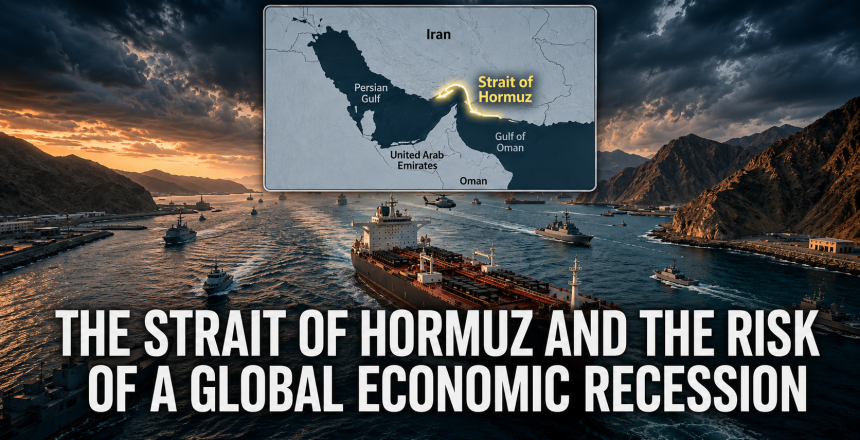
Today, all eyes are on a geographical point just 33 kilometers wide: the Strait of Hormuz. Located between Iran and Oman, this passage connects the Persian Gulf with the Gulf of Oman and the Arabian Sea, acting as the main artery of the international energy system.
What happens in this strait doesn’t stay confined to the Middle East. It is transmitted, almost immediately, to the rest of the world in the form of higher prices, greater uncertainty, and more complex economic decisions.
At a time when the global economy is already facing pressures, persistent inflation, high interest rates and lower growth, any disruption in Hormuz could become a large-scale destabilizing factor.
In this installment of Energy 4.0 , I seek to address a topic that seems distant, but has direct implications for everyone: how a localized event can quickly escalate into a risk of global recession.
Throughout this article we will address the following questions:
- Why is the Strait of Hormuz so critical to the global economy?
- What is happening today and how real is the risk of total disruption?
- How is this shock transmitted from energy to inflation, interest rates, and growth?
- Which regions and sectors are most exposed to this risk?
- What can countries—and particularly Latin America—do to prepare for or even take advantage of this scenario?
1. The Strategic Importance of Hormuz
The Strait of Hormuz is probably the most important energy chokepoint in the world. Nearly 20% of the world’s oil passes through it , but its significance goes far beyond crude oil:
- Approximately 19% of the world’s maritime trade in liquefied natural gas (LNG)
- Approximately 29% of the global LPG (liquefied petroleum gas) trade
- Around 19% of refined products (diesel, gasoline, jet fuel)
- Approximately 13% of chemicals and fertilizers
- Even a smaller but relevant fraction of containers and dry bulk

In other words, it’s not just an energy step… it’s a critical point for multiple global supply chains with very few alternative routes.
This means that a significant part of what drives it:
- transport
- the industry
- agriculture
- and global trade
It depends on the stability of this strait.
The evidence is showing that the shock does not depend solely on the “physical closure” of the strait: the escalation of risks + insurance + costs can “close” the passage by market decision.
- “War risk” costs multiplied (UNCTAD illustrates a typical premium of 0.25% in the pre-crisis scenario and escalations that can raise the cost per trip from US$250k to US$1M for a US$100M vessel).
- At the same time, tanker freight rates rose sharply (BDTI +54% and BCTI +72% in days) and bunker fuel in Singapore roughly doubled.

https://edition.cnn.com/2026/03/26/middleeast/how-iran-controls-strait-of-hormuz-explained-intl-vis
2. Recent Chronology of Incidents
What has happened in the Strait of Hormuz over the last five years is not a coincidence… it follows a clear pattern of progressive escalation.


First, isolated incidents began:
- In 2021 and 2022, oil tankers were seized as part of political tensions and sanctions.
Then, the situation became more frequent and complex:
- In 2023 and 2024, seizures and boardings of ships, used as tools of geopolitical pressure, increased.
Later, the risk began to impact the market:
- In 2025, insurance costs rose sharply and some routes began to change.
And finally, in 2026, the risk escalated to another level:
- Maritime traffic fell drastically
- The energy supply was reduced
- Prices and logistics costs increased
- And there was even talk of insurance to evacuate crews.

3. Most Exposed Regions
The impact of a disruption in the Strait of Hormuz is not felt the same way around the world. Some regions are much more vulnerable than others.
- Asia: the epicenter of the impact. Most of the oil and gas passing through the Hormuz Strait is destined for Asia—around 80% or more . This means that countries like China, India, Japan, and South Korea are the first to feel the impact, with immediate increases in energy costs, inflation, and pressure on their economies.
- Europe: indirect but significant impact . Europe is less directly dependent on Hormuz, but highly exposed to global prices. If oil or natural gas prices rise, sectors such as aviation, transport, and industry see significant increases in their costs.
- Emerging economies: the most vulnerable . Many developing countries lack the fiscal space and economic stability to absorb these shocks. The impact is reflected in higher inflation, increased pressure on energy subsidies, higher debt, and a greater cost of living. In these cases, the most critical effects are usually on food and transportation.

In summary, Asia receives the direct impact, Europe absorbs it through prices, and emerging economies suffer the deepest consequences.
4. Policy and Mitigation Options (and Limitations)
When a disruption occurs at a critical point like the Strait of Hormuz, countries and markets don’t stand idly by. Several tools exist to mitigate the impact… but they all have significant limitations.
In other words, there are options, but none of them is a complete solution.
1. Use of strategic reserves
Consumer countries maintain oil reserves precisely for these types of crises. In 2026, the International Energy Agency coordinated the release of 400 million barrels, the largest in its history.
This helps to stabilize the market in the short term and avoid extreme price spikes.
But there’s a problem: these reserves are a “cushion,” not a permanent solution.
If the disruption lasts for weeks or months, reserves begin to run out and the problem reappears.
2. Reduction of consumption (demand management)
Another mitigation alternative is to consume less energy. This includes measures such as:
- more teleworking
- flight reduction
- speed limits
- greater energy efficiency
The goal is to lower demand and ease pressure on prices.
However, these measures help… but they don’t replace the lost supply.
They are useful for buying time, not for solving the underlying problem.
3. Alternative routes and logistics
There are some alternatives to transporting oil without going through Hormuz, mainly pipelines in Saudi Arabia and the United Arab Emirates.
The problem is one of scale: these routes can only cover a small portion of the flow. While approximately 20 million barrels per day pass through Hormuz , the additional capacity available via other routes is a mere 2–3 million .
https://www.eia.gov/todayinenergy/detail.php?id=65504
This means that, although they help, they cannot compensate for a complete disruption.
4. Maritime security and military operations
Another option is to try to guarantee transit by:
- naval escorts
- demining operations
- creation of safe corridors
The need for protected evacuation routes for crews in high-risk situations has even been raised. However, these types of operations are complex, costly, and politically sensitive.
Furthermore, in an environment with threats such as missiles or drones, guaranteeing total security is extremely difficult.
5. The critical role of the insurance market
Here’s a key point that often goes unnoticed: without insurance, ships can’t sail. In high-risk situations, insurers:
- Premiums rise sharply
- or they simply stop covering certain routes
This can “close” the strait in practice, even if it physically remains open.
That’s why initiatives like special “war risk” coverage programs seek to keep global logistics operational.
But rebuilding market confidence takes time… and depends on perceived risk decreasing.
5. Macroeconomic Channels Towards a Global Recession
It is clear that when a disruption occurs in the Strait of Hormuz, the impact is not limited to the energy sector. It is transmitted throughout the economy via various channels that, moreover, reinforce each other.
1. Increase in energy prices
The first effect is immediate: oil and natural gas prices rise. In recent episodes, the price of crude oil approached US$120 per barrel during periods of heightened tension.
This translates quickly to:
- more expensive fuels
- more expensive electricity (generally)
- increase in transportation costs
In other words, it directly impacts people’s wallets and companies’ costs.
2. Lower purchasing power and a drop in consumption
When energy becomes more expensive, it acts as an “invisible tax”.
Families have to spend more on gasoline, electricity, and transportation, which reduces the money available for other expenses. Businesses, meanwhile, see their profit margins shrink.
The result is clear: less consumption and less economic activity.
In some cases, we even see what is known as “demand destruction”: fewer flights, less energy use, and reduced economic activity in response to high prices.
3. Pressure on central banks and persistent inflation
When energy prices rise, inflation also rises.
This puts central banks in a difficult position:
- If interest rates rise, they curb inflation but also growth.
- If they don’t, inflation could remain high for longer.
Furthermore, there is a risk that this price increase will “spread” to other sectors (wages, services, food), generating a chain reaction that is more difficult to control.
4. Increased financial pressure and more expensive access to credit
The fourth channel is financial. When uncertainty and energy costs increase, markets react:
- Interest rates rise
- financing becomes more expensive
- This increases the pressure on indebted countries and companies
This particularly affects emerging economies, which have less room to absorb these shocks.
An effect that spreads throughout the entire economy
These four channels do not operate separately. They combine and amplify each other.
Furthermore, in a highly interconnected world, the impact is quickly transmitted through global supply chains:
- More expensive energy → more expensive transport
- more expensive transport → more expensive products
- More expensive inputs → lower production
Even sectors that are not directly related to energy end up being affected.
World Bank studies show that these types of global shocks explain a significant part of inflation in many countries, confirming that the impact is broad and systemic.
5. Conclusion
What is happening in the Strait of Hormuz is not simply another geopolitical issue. It is, in fact, a stark reminder of how the world works today: highly interconnected, dependent on a few critical nodes… and vulnerable to rapidly escalating disruptions.
Recent history teaches us a clear lesson: a complete closure of the Strait of Gibraltar is not necessary to generate a global shock. It only takes an increased perception of risk, higher insurance costs, strained logistics, and altered market expectations for the impact to spread.
And when that happens, the transmission is almost immediate: energy → inflation → interest rates → growth. That is the real systemic risk.
For Latin America, this scenario presents a double challenge—and also an opportunity.
- On the one hand, the region remains highly sensitive to international energy prices , with direct impacts on inflation, fiscal accounts and macroeconomic stability.
- But, on the other hand, it also has the potential to position itself as part of the solution: with diversified energy resources, regional production capacity, and opportunities to strengthen its energy security.
The question then is not whether these types of events can occur… but how prepared we are when they do occur and how we build resilience to reduce our structural dependence.
In an environment where uncertainty has ceased to be the exception and has become the norm, energy resilience, diversification and the ability to anticipate are no longer competitive advantages… but have become necessary conditions.
References
Strait of Hormuz Disruptions – Implications for Global Trade and Development https://unctad.org/system/files/official-document/osgttinf2026d1_en.pdf
Disruption in the Strait of Hormuz is a global inflation, shipping and growth story https://blogs.lse.ac.uk/businessreview/2026/03/12/disruption-in-the-strait-of-hormuz-is-a-global-inflation-shipping-and-growth-story/
The closure of the Strait of Hormuz and its impact on the global supply chain https://blog.nowports.com/es/cierre-estrecho-de-ormuz-y-su-impacto-en-la-cadena-de-suministro-global