


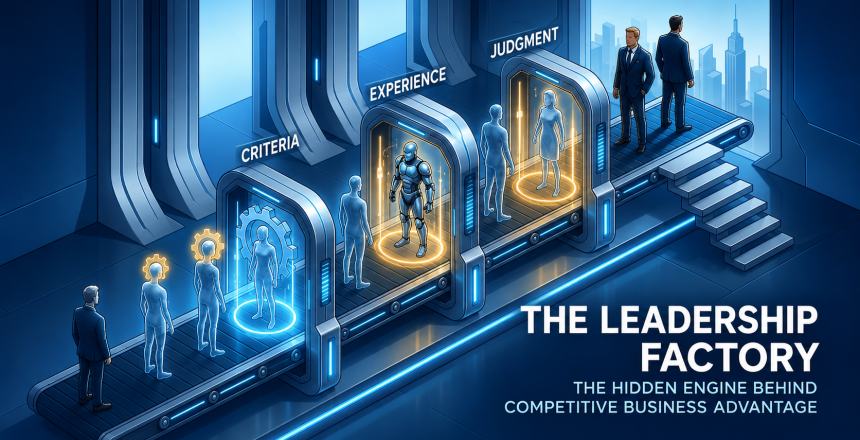
When we talk about competitive advantage, we usually think about technology, innovation, costs, scale, or strategy. But there’s a silent engine—much harder to copy—that explains why some companies thrive for decades… and others don’t survive the next crisis.
That driving force is leadership . Or more precisely: a company’s ability to consistently produce leaders .
I’m not talking about charisma. I’m not talking about extraordinary individual talent. I’m not talking about weekend leadership courses.
I’m talking about a system .
What exactly is a “leadership factory”?
A leadership factory is an organization that doesn’t rely on “external saviors or heroes ,” but rather on processes. It intentionally develops the people who will one day make key decisions.
Companies like Procter & Gamble, Goldman Sachs, and General Electric (at their peak) understood something key decades ago: Leadership isn’t improvised or bought at the last minute. It’s built over time, with experience and sound judgment.
For decades, Procter & Gamble was known for an unwritten rule: ” CEOs are not hired, they are made .”
For years, these organizations deliberately invested in job rotations, demanding assignments, and early exposure to critical decisions. Not to “motivate,” but to prepare .
The result: continuity, resilience, and superior execution .
This model showed that companies with strong internal promotion tend to have better long-term performance , lower executive turnover, and greater strategic coherence.
It wasn’t about having leaders who were brighter than the market, but about having leaders who were better prepared for that specific context .
This approach has been widely documented by Harvard Business Review and McKinsey & Company , both of which identify the leadership pipeline as one of the most determining factors of long-term corporate sustainability.
Why does this matter today more than ever?
Because the context has changed. The current environment severely penalizes improvisation.
Today, companies operate in a context marked by:
- Persistent geopolitical volatility
- Accelerated technological disruption (including AI)
- Pressure for immediate results
- New expectations about purpose and human leadership
In this scenario, failing in leadership is extremely costly .
According to the Boston Consulting Group , more than 60% of strategic transformations fail, and one of the most recurring factors is leadership that is insufficiently prepared to execute the change .
Furthermore, PwC studies show that externally hired CEOs typically take between 24 and 36 months to reach levels of effectiveness comparable to internally trained leaders.
Some other facts that should give us pause:
- Companies that develop leaders from within tend to retain more talent and reduce turnover costs.
- Markets value stability: when a company has a clear succession plan, confidence increases.
In a world of high uncertainty, time is a luxury.
In short: poorly managed leadership becomes a strategic risk .
The most common mistake: thinking of leadership as a “program”
Many organizations claim, “We have leadership programs .” But a leadership factory isn’t a program . It’s a system that answers uncomfortable questions like:
- Who could replace our key leaders tomorrow?
- What real-world experiences are we giving our talent, beyond courses?
- Which leaders are developing successors and which are simply delivering results?
When these questions do not have a clear answer, the familiar pattern appears:
- Talent is being sought from outside “because there’s no one ready,” “We have to go out into the market,” “Let’s bring in external experience”
- The cycle of turnover, cultural friction, and loss of critical knowledge repeats itself.
The World Economic Forum has warned that a lack of prepared leadership is one of the main risks to organizational resilience in complex environments.
What does a leadership factory look like in practice?
Organizations that do well aren’t perfect, but they share five clear habits:
- They identify talent early : They not only measure performance, but also judgment and the ability to learn under pressure.
- They expose people to real challenges: Leadership is forged through decisions with consequences. Complex projects, uncomfortable roles, impactful decisions.
- They promote from within whenever possible: Not for convenience, but because they know their people better than the market.
- Leaders develop leaders: Training successors is an explicit part of the managerial role; those who do not train successors do not belong to the team.
- The CEO gets personally involved: Without sponsorship from above, the factory will never get started.
The contrast: when the factory does not exist
Business history is full of brilliant companies that went into crisis not because of a lack of products, but because of leadership gaps .
Constant changes in CEO. Contradictory strategies. Erratic decisions. Loss of internal and external trust.
All symptoms of the same thing: 👉 there were no leaders ready when the time came.
A final reflection
In Beyond Energy I talk a lot about leadership in complex environments, about purpose, judgment, and humanity.
The leadership factory connects directly with that.
Because in the end:
- Strategy is designed by people.
- Risk is managed by people.
- Transition, innovation, and resilience… too.
Companies that understand this don’t just compete better. They transcend better .
Perhaps the question isn’t: Do we have a good strategy?
Otherwise: Do we have enough leaders prepared to implement it today… and tomorrow?
That’s where the real hidden engine lies.
References
Developing Your Leadership Pipeline https://hbr.org/2003/12/developing-your-leadership-pipeline
Scaling up the 21st-century leadership factory https://www.mckinsey.com/featured-insights/destacados/llevar-a-escala-la-fabrica-de-liderazgo-del-siglo-xxi//es
McKinsey & Company – Establish a talent-first organization https://www.mckinsey.com/capabilities/people-and-organizational-performance/how-we-help-clients/talent
Leadership with a Powerful Purpose https://www.bcg.com/publications/2023/leading-with-purpose-for-transformation-success