


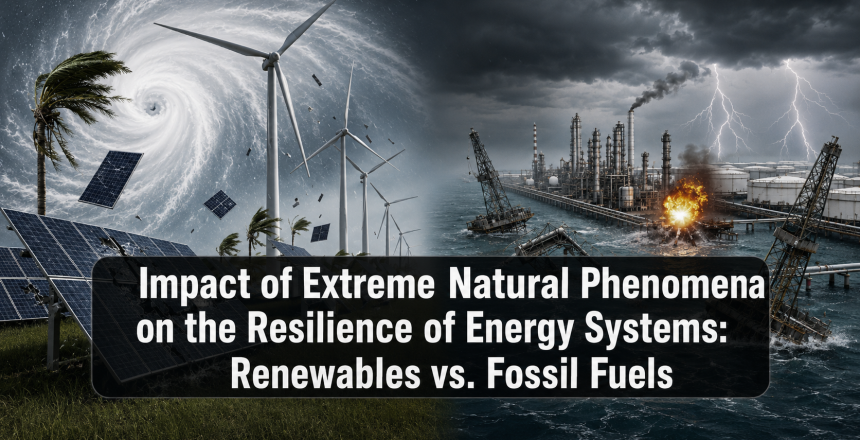
Scientific evidence confirms that extreme weather events are becoming more frequent and intense : more powerful hurricanes, heavier rainfall, more severe storms, and prolonged droughts that test the resilience of electrical infrastructure. The IPCC warns of an increase in the proportion of Category 4–5 hurricanes under warming scenarios, as well as significant increases in rainfall rates per storm, raising the risk of flooding and damage. In turn, more extensive and severe droughts limit hydroelectric generation and underscore the need to diversify with other energy sources.

On the other hand, electricity is the service that most critically concentrates all these risks: the backbone of modern life . Hospitals, communications, water supply, transportation, and virtually the entire economy depend on it. Without electricity, everything grinds to a halt . Precisely because of its essential nature, electrical systems often become the Achilles’ heel in the face of natural disasters. The 2017 hurricane season (Irma and Maria) starkly demonstrated this in the Caribbean: collapsed power grids and months of blackouts. In small island states, a single extreme event can paralyze the country and cause losses of nearly 9% of GDP . l in the face of natural disasters. The 2017 hurricane season (Irma and Maria) starkly demonstrated this in the Caribbean: collapsed power grids and months of blackouts. In small island states, a single extreme event can paralyze the country and cause losses of nearly 9% of GDP .
https://elpais.com/internacional/2017/09/11/estados_unidos/1505148280_478266.html
https://actualidad.rt.com/actualidad/250717-huracan-maria-dejar-energia-puerto-rico
https://www.jornada.com.mx/2017/09/22/mundo/036n1mun
While we cannot control the occurrence of hurricanes, storms, or tornadoes, it is possible to prepare energy systems to better withstand their impacts and recover more quickly. Given this reality, energy resilience —anticipating, absorbing, adapting, and recovering—becomes imperative.
This edition of Energy 4.0 examines the capacity of different electrical system designs—from centralized schemes based on fossil fuels to distributed configurations based on renewable energy—to respond to extreme natural phenomena. The analysis incorporates key lessons learned from the most significant events of the last two decades, identifying vulnerabilities and strengths inherent in each model. It also formulates energy policy and planning recommendations aimed at strengthening systemic resilience to the risks associated with a changing climate.
Impacts of Extreme Events on Energy Infrastructure
When nature strikes, the first thing to fall is usually the electrical infrastructure. Transmission towers and poles give way, substations are damaged, and power plants face flooding, technical failures, or outages due to fuel shortages. The following is a summary of the most common damage that extreme events cause to energy infrastructure.
- Generation Systems: In the case of renewable sources , wind turbines can be damaged by extreme winds exceeding their design tolerance (typically ~55 m/s); there have been incidents of wind turbines collapsing or with shattered blades after the passage of unusually violent cyclones. Photovoltaic solar farms are vulnerable to strong winds and projectiles (debris) that break panels, as well as severe hailstorms. For example, exceptional hail during severe storms in Texas and Australia has broken thousands of solar modules in minutes, disrupting generation. In hydroelectric power plants, torrential rains can cause flooding that damages electromechanical equipment or compromises the structure of dams and spillways. In addition, landslides and debris associated with storms can obstruct channels or penstocks, temporarily taking hydroelectric plants offline. Meanwhile, fossil fuel power plants are generally designed with robust structures, but they are vulnerable to flooding in substations, control rooms, pumping systems, and grounding systems; Hurricanes Sandy (2012) in the US and Hagibis (2019) in Japan forced shutdowns. Storms can also trigger fires and explosions at hydrocarbon facilities.
- Supply Chains: Beyond physical damage, natural disasters expose the vulnerability of fossil fuel supply chains. Hurricanes, storms, or extreme cold close roads, bridges, ports, and platforms, which can disrupt the transport of coal, natural gas, diesel, or fuel oil, paralyzing power generation even if the plants themselves remain intact. Natural gas, although transported by pipelines, is not exempt: winter extremes can freeze equipment and pipes. Renewable energy sources, on the other hand, do not depend on external fuel ; after the event, the “input” (sun/wind) returns without logistical issues. The dependence is on spare parts if there was physical damage. This is a structural advantage; installed wind/solar plants are protected from disruptions in fuel supply chains throughout their lifespan. In contrast, coal, gas, or diesel power plants require continuous refueling; they typically maintain limited reserves on-site (days or weeks of fuel), so a prolonged closure of ports or pipelines could deplete their reserves and force them to shut down. Even nuclear power plants, with fuel reserves for years, need an external supply of diesel for their emergency generators, as seen in Fukushima in 2011 when the tsunami depleted diesel reserves and the nuclear disaster occurred.
- Transmission and Distribution Systems: Hurricane-force winds topple power towers and poles, causing massive blackouts even if the power plants themselves remain intact. For example, in Puerto Rico after Hurricane Maria (2017), gusts of approximately 250 km/h brought down roughly 80% of the island’s power grid. The result was the largest blackout in U.S. history, with some rural areas taking up to 11 months to have their power restored. In the Philippines (Haiyan, 2013), nearly 2,000 transmission structures were destroyed. Japan (Faxai/Hagibis, 2019) demonstrated that even high standards can be compromised by exceptional typhoons. Tornadoes (Alabama, 2011) forced the shutdown of a nuclear power plant. No one is immune when nature strikes hard.


- Duration of outages and speed of recovery: In conventional centralized systems , restoring electricity typically involves repairing transmission/distribution infrastructure and restarting large generating plants. If the damage is severe, recovery can be very slow and costly. In systems with high penetration of distributed renewables and microgrids , experience suggests that certain segments can recover more quickly on their own. In any case, it is important to note that renewable energy sources can also experience recovery delays if they have suffered extensive damage. Repairing or replacing hundreds of damaged wind turbines could take months due to logistical complexity (specialized cranes, supply of new wind turbines). Similarly, replacing thousands of solar panels destroyed by a hurricane requires stock availability and installation. However, a differentiating factor is renewable modularity : if only a subset of the renewable units is damaged, the others can continue operating. A partially affected solar farm can resume production at some capacity while the broken panels are gradually replaced. In contrast, in a large fossil fuel plant, a catastrophic failure (e.g., boiler explosion, roof collapse) usually means total loss of the unit until major repairs, leaving a complete capacity gap during that time.
The resilience of an energy system is reflected in how quickly and at what cost it can restore supply after an extreme event. This is where important differences emerge between centralized fossil fuel systems and distributed renewable energy systems.
In short, extreme events reveal that centralized fossil fuel systems tend to “go down louder”—massive blackouts when a critical node fails—and their restoration is often more costly and time-consuming, given the scale involved. Distributed renewable energy systems tend to fail in a more localized manner; they can isolate parts (thanks to microgrids), and their components can be repaired or replaced more gradually. This doesn’t mean that renewables are invulnerable, but rather that they offer flexibility and redundancy that is advantageous for resilience.
Vulnerabilities and Strengths: Renewable Systems vs. Fossil Systems
The following compares the main resilience characteristics of renewable energy-based systems (particularly when distributed in decentralized networks) versus centralized conventional fossil fuel systems.

1. Systems with High Renewable Penetration (solar, wind, hydro)
- Physical vulnerability: Dispersed and modular infrastructure. Advantage: Geographic distribution limits simultaneous catastrophic damage – it is unlikely that all turbines or panels will fail at once, allowing some capacity to remain operational. Weakness: Wind farms in hurricane-prone areas face a risk of structural damage; manufacturers improve designs (more robust towers, blades with feathering modes) but do not eliminate the risk of collapse in exceptionally high winds. Solar panels can be secured with hurricane-resistant supports, but remain exposed to extreme winds and projectiles. Large hydroelectric plants are vulnerable to extreme flooding that compromises dams or triggers emergency floodgate openings.
- Modularity and redundancy: By their nature, renewables are composed of many small units (thousands of panels, dozens of turbines). Advantage: Partial failures do not collapse the entire system; there is inherent distributive redundancy. For example, if 10 out of 50 wind turbines are damaged, the park can still generate power with the remaining 40. Furthermore, distributed generation in microgrids can be isolated and operate independently if the rest of the grid fails. Weakness: Managing many units can complicate recovery coordination (more dispersed technicians are required to reconnect numerous small systems).
- Grid inertia and stability: Generation using electronic inverters (solar, wind) contributes little rotational inertia to the electrical system, which can make frequency maintenance difficult after disturbances. Weakness: In grids with a very high percentage of renewable energy without countermeasures, sudden events (e.g., sudden disconnection of several units) can cause more abrupt frequency/voltage variations than in traditional systems with heavy synchronous generators. However, advances in synthetic inertia using grid-forming inverters , along with the use of batteries, are enabling ultrafast regulation in milliseconds, providing frequency support and ancillary services more efficiently than the passive inertia of fossil fuel turbines, which can translate into greater resilience to extreme events. Advantage: Batteries can provide ultrafast regulation, contributing to stability during extreme transients better than the passive inertia of a turbine.
- Supply chains: They do not require external fuel during normal operation. Once installed, solar/wind systems utilize inexhaustible local resources, eliminating the risk of external supply shortages during a disaster. Advantage: After an event, they do not depend on reopening ports or pipelines to resume generation; if the wind blows or the sun shines, they can produce. Weakness: Dependence on imported replacement components if there is damage, which can take months (e.g., the need for new blades if the originals are destroyed).
- Weather dependence: Variable generation subject to weather conditions (solar irradiance, wind, water flow). They may require storage or backup power during extreme events (e.g., solar power does not generate at night or under dense cloud cover during storms). Disadvantage: They may have momentary zero output during the event (e.g., wind farms shut down in winds > 100 km/h for safety). Advantage: The “fuel” (sun/wind/water) reappears free of charge after the event, allowing for rapid resumption if the installations survive.
- Post-event recovery: Advantage: If key facilities survive, renewable generation can resume immediately as soon as conditions return (sun, wind) without waiting for inputs. The decentralized nature allows communities with their own generation (domestic solar panels, minigrid turbines) to restore local service even if the national grid is down. Repairing or replacing damaged components (poles, inverters, panels) can be done in parallel at multiple small sites, sometimes involving the local community, instead of relying on rebuilding monolithic nodes. For example, after hurricanes, local crews have reinstalled rooftop solar panels in days, restoring basic power, while reconnection to the central grid took weeks. Weakness: It may require external support to replace equipment if there is no local stock (e.g., wind turbines require specialized cranes for major repairs). Furthermore, intermittency can mean that, during the night immediately following the disaster, even if the solar infrastructure is intact, there is a reliance on batteries or backup power until the next day.
- Recovery costs: The costs of repairing renewable energy systems after a disaster vary depending on the extent of the damage. Replacing rooftop solar panels is relatively inexpensive and quick compared to rebuilding large plants—some post-hurricane relief programs have installed solar and battery kits in hundreds of homes for the equivalent cost of repairing a few kilometers of conventional distribution lines. Modularity allows for phased reconstruction investments (prioritizing the energization of critical sites with portable panels, etc.). Furthermore, “build back better” often involves taking the opportunity to increase the share of renewable energy, as seen in Puerto Rico, where, following Hurricane Maria, a grid reconstruction focused on resilient distributed resources (DER) is being promoted.
2. Systems based on Fossil Fuels (coal, natural gas, fuel oil)
- Physical vulnerability: Concentrated, large-scale infrastructure. Thermal power plants are typically built to withstand earthquakes and strong winds; heavy equipment (turbines, boilers) is usually housed in reinforced buildings. Advantage: Greater individual physical protection: a medium-category cyclone is unlikely to destroy a robust concrete/enclosed power plant – they generally withstand storms better than, for example, exposed wind turbines. Weakness: Single points of failure: if a large plant suffers major damage (fire, severe flooding), a large block of capacity is lost at once. Centralized fossil fuel grids depend on a few plants; the failure of one due to a disaster can remove, for example, 30% of a small country’s generation.
- Modularity and redundancy: Power plants with large unit capacities. Weakness: A single point of failure can take a large amount of generation out at once (e.g., the failure of a 500 MW plant takes away more power than the loss of dozens of individual turbines). Redundancy must be planned by adding extra capacity (reserve margin), which increases costs.
- Inertia and stability: The large turbines and synchronous generators of fossil fuel plants provide substantial inertia, acting as “shock absorbers” that help maintain a stable frequency in the face of sudden changes in load or generation. Advantage: This natural inertia has traditionally been key to operational resilience during disturbances. In addition, many fossil fuel plants can easily provide reactive power and voltage control. Weakness: During a disaster that forces them to shut down (due to a fault or protection failure), this inertia disappears; moreover, relying on inertia is of no help if the entire plant is out of service due to damage or lack of fuel. In recovery scenarios, fossil fuel systems have experience with black start procedures for large units to re-energize the grid, while renewables are still developing this capability (although batteries and microgrids are demonstrating new approaches to autonomous start-up).
- Supply chains: Absolute dependence on fuel supplies. Weakness: A disaster that disrupts transportation routes (closed ports, cut-off roads) or production infrastructure (wells, refineries) prevents power plants from being fed. On-site reserves (diesel tanks, coal yards, stored gas capacity) are usually limited (days or weeks); if external infrastructure is not restored quickly, generation ceases. The reliability of fossil fuel plants during cold events depends critically on a continuous flow of gas.
- Weather dependence: Firm generation is not dependent on weather for production (a natural gas or coal plant can operate 24/7 under normal conditions). Advantage: They can continue generating during moderate adverse weather conditions, providing firm power. Weakness: They depend on fuel logistics.
- Post-event recovery: Weakness: Re-energization typically depends on restoring the transmission grid and having at least some large plants operational. If the infrastructure was severely damaged, recovery times are long (months) due to the scale of the repairs. Replacing a single large thermal power plant can take weeks just for cleaning and inspection, and months if it requires partial reconstruction. Advantage: Fossil fuel plants can provide controllable power once restored, making it easier to re-energize sections of the grid in a coordinated manner (in comparison, variable renewable generation may need to be carefully managed during re-energization to avoid instability). However, this advantage only operates after the plant is back online and fueled – which, as discussed, can be the most time-consuming part.
- Recovery costs: Repairing conventional electrical infrastructure after disasters represents enormous expenses: rebuilding downed transmission lines, replacing burned-out transformers, and restoring damaged plants entails multimillion-dollar emergency investments. These are unforeseen costs that typically fall on governments or insurance companies (where they exist), impacting the finances of local utilities. Investing in proactive resilience (such as burying lines or reinforcing structures) has high upfront costs but is profitable in the long run. However, many fossil fuel systems in developing countries postpone such investments, becoming financially vulnerable when the worst-case scenario occurs.
In general terms, well-designed renewable energy systems tend to be more flexible and self-sufficient , while fossil fuel systems offer firm power but are more rigid and dependent on external inputs . The World Economic Forum report “Fostering Effective Energy Transition” summarizes:
“Each energy source offers advantages in resilience but also its own risks. Therefore, experts emphasize diversification and complementarity: a balanced energy mix with multiple sources reduces the likelihood of losing a large proportion of generation at once due to a single event.”
Mitigation and Adaptation Strategies to Improve Resilience
Given the growing threat of extreme events to electrical systems, multiple technical and management strategies have been developed aimed at both mitigating potential damage —through infrastructure hardening and the adoption of stricter construction standards—and improving resilience through adaptation, storage, and rapid response measures. These actions leverage the strengths of renewables (e.g., modularity and distributed generation), compensate for their weaknesses (e.g., low inertia, variability), and reinforce the vulnerabilities of fossil fuel systems (e.g., dependence on fuel supply). In this section, we will examine concrete examples of successful implementation that illustrate how these strategies can translate into more resilient energy systems in the face of extreme events.
- Distributed Generation and Renewable Microgrids: Deploying local microgrids with their own generation (solar photovoltaics, small wind turbines) and backup batteries allows communities or critical facilities to disconnect from the main grid during a disaster and continue operating in isolation. This strategy has been adopted in military bases, hospitals, gas pipelines, telecommunications, and emergency services. For example, in Puerto Rico, rural communities are installing solar microgrids to avoid relying on the vulnerable power lines of the electric company; after Hurricane Fiona (2022), many homes with solar panels and batteries barely noticed the general blackout, powering refrigerators, lights, and basic communications with their own system. Microgrids offer modularity and rapid recovery—as soon as the storm passes and the sun shines again, these communities can self-restore their power. Promoting them is a key recommendation for “building back better” in disaster-prone regions.
https://rmi.org/resources/ready-for-a-wild-hurricane-season-renewable-microgrids-are
- Energy Storage and Backup Sources: The incorporation of stationary batteries and other forms of storage (flywheels, liquid air, pumped hydro) strengthens resilience by fulfilling two essential functions. First , they store surplus renewable energy during normal times and make it available during emergencies, maintaining supply when variable generation declines (e.g., during a hurricane). Second , batteries can provide instantaneous support to the grid: their millisecond response helps stabilize frequency and voltage if fluctuations occur during disruptive events. Numerous Caribbean islands are installing grid-scale batteries to operate in isolation when interconnection cables or main power plants fail. Additionally, having backup generators (diesel, gas, or even better, biodiesel and biogas in the future) at hospitals, water treatment plants, and other critical infrastructure remains important. The key is to diversify backup options.
Solar Energy and Hurricane Preparedness: Building Resilient Communities in the Caribbean
- Burying and reinforcing power lines: One of the most direct methods for reducing wind damage is burying power lines in critical areas. Although burying transmission and distribution cables involves high initial costs, it has been shown to drastically decrease vulnerability to hurricanes, storms, and even fires. In addition, physically reinforcing existing overhead infrastructure is crucial: replacing wooden poles with concrete or galvanized steel poles, installing larger gauge cables or cables with salt-resistant insulating coating (important in coastal areas), and widening right-of-way (pruning or removing nearby trees that could fall on lines). For example, the Netherlands has buried almost 100% of its distribution network, protecting it from storms in northern Europe.
https://www.zoliov.com/blog/where-underground-cables-are-used-2
- Disaster-Resistant Design and Standards: Updating design codes and regulations for new energy installations can significantly increase their ability to withstand extreme events. For example, requiring wind turbines in hurricane-prone areas to have roll-off (folding) or safety positioning mechanisms, and increasing their structural strength to withstand winds up to Category 5; the latest offshore turbine designs in Asia incorporate reinforced foundations and towers due to more powerful typhoons recorded in the last decade. In the case of solar panels, Puerto Rico and Florida have adopted installation standards that account for gusts of 180-200 km/h (with extra anchors and aerodynamic profiles), learning from failures where poorly secured panels were blown away. For fossil fuel power plants, recommended measures include raising essential equipment above potential flood levels (e.g., locating emergency generators and control centers at safe heights), using flood levees or retaining walls around substations, and improving winterization : after 2021, Texas and other southern US states implemented mandatory winterization standards for gas and coal plants, including heat tracers in pipelines, valve sheds, and fuel contingency plans. While these improvements come at a cost, regulators note that they are essential given that extreme cold events are no longer “black swans” but are becoming increasingly frequent. Another aspect is strengthening telecommunications and control systems : ensuring that power plants and substations have redundant communications (satellite radio, etc.) and backup power to coordinate recovery even if normal telecom networks fail.
https://rmi.org/resources/solar-under-storm-designing-hurricane-resilient-pv-systems
https://www.mrt.com/news/article/texas-energy-winter-preparation-19986773.php
- Diversification of the Energy Matrix and Backup Sources: A national resilience strategy is to diversify generation sources to avoid relying entirely on a single vulnerable technology. A balanced mix of renewables—solar, wind, and hydropower—combined with some manageable thermal capacity or storage, tends to be more robust in the face of any particular event. For example, in a severe drought that reduces hydroelectric power, having installed solar and wind farms provides compensation (as seen in California or Brazil during dry years); conversely, in a heat wave without wind, hydropower or geothermal energy can provide backup. Temporal complementarity is key: wind often blows at different times of day than solar radiation, and hydropower can provide backup during short peaks. Furthermore, maintaining some distributed generation capacity with biogas, biomass, or micro gas turbines for emergencies can help sustain the grid when other sources are unavailable. Diversification reduces the probability of simultaneous catastrophic failure of the generation fleet, improving systemic resilience.
An illustrative case is Germany: during the 2022 energy crisis (not climate-related but geopolitical), its high share of renewable energy (~50%) allowed it to cope with the reduction in Russian natural gas with less impact, maintaining a stable electricity supply and cushioning prices. Renewables acted as “internal insurance,” reducing exposure to an external fuel shock.
- Response Plans and Controlled Shutdowns: Preparing comprehensive emergency protocols allows for shortening the duration of blackouts and reducing secondary risks. This includes: early warning systems and dedicated weather monitoring for the energy sector (e.g., forecasting centers specializing in predicting infrastructure impact), and plans for orderly shutdowns before the event arrives (often it is better to proactively shut down certain plants or lines to avoid greater damage). An emerging concept is to implement planned “rotating blackouts” when an extreme event that could overload the system is approaching—for example, proactively reducing demand in certain areas to relieve pressure on the grid and prevent a total collapse. It is also crucial to ensure post-event logistics: having repair teams contracted from other regions (mutual aid agreements between electric companies), strategically stockpiling replacement materials (poles, transformers, cables) inland, away from the disaster’s reach, and having personnel trained to operate under crisis conditions.
The case of Florida after Ian showed the effectiveness of this: more than 20,000 electric company workers from 34 states were pre-positioned and quickly went into action after the hurricane, restoring service to millions in a few days.
- Long-Term Climate Change Adaptation: Many strategies focus on building infrastructure prepared for the most severe future conditions anticipated. This involves reassessing design parameters using climate projections: for example, if power lines were previously designed for 200 km/h winds, they might now be designed for 250 km/h in the Caribbean, considering the potential intensification of hurricanes. In coastal areas , the expected sea level rise and scenarios for higher storm surges should be included in risk assessments for power plants and substations. In drought-prone areas, new renewable capacity should be planned not only in hydroelectric plants but also by diversifying with solar and wind power to guarantee generation during dry years. Adaptation also encompasses innovative solutions such as multi-purpose infrastructure : using floating solar farms on hydroelectric reservoirs (reducing evaporation during droughts and providing extra energy during outages), or integrating electric vehicles as backup (V2G, vehicle-to-grid) to provide emergency power.
- Financing Mechanisms for Resilience and Recovery: Building resilience requires investment. Another recommended strategy is for governments to establish specific funds and credit lines for energy resilience projects. For example, a national Energy Resilience Fund could co-finance the undergrounding of critical power lines, the construction of protective dikes at coastal plants, or the purchase of mobile backup equipment.
- Regional Cooperation and Exchange of Best Practices: Extreme weather events often affect entire regions, so response and preparedness must transcend borders. Strengthening regional collaboration networks between electric utilities and governments is recommended to share resources and knowledge on resilience. A successful model is the Mutual Assistance Agreement among North American electric utilities, which has enabled the rapid deployment of thousands of electrical workers from one state to another after hurricanes.
- Community empowerment and a focus on equity: Finally, it is essential to prioritize the protection of critical sectors and vulnerable communities. Empowering citizens through emergency preparedness education and basic training in operating microgrids or community backup systems strengthens local response capacity. Likewise, providing tangible resources —such as distributed off-grid equipment, portable solar power kits, or backup systems for essential services—contributes to making society as a whole more resilient, reducing vulnerability gaps, and ensuring a more equitable recovery after extreme events.
Conclusions
The extreme natural events of recent decades have revealed both the fragility and the potential resilience of our energy systems. The most violent tropical storms—from Caribbean hurricanes to Asian typhoons—have brought entire power grids to their knees, exposing the high human and economic costs of being without electricity for weeks or months. However, they have also spurred innovation and transformation: communities adopting distributed renewable energy to take control of their own supply, utilities redesigning their grids with resilience in mind, and governments recognizing that energy security in the age of climate change is not just about price and supply, but about withstanding and recovering from the unexpected.
The comparison between fossil fuel and renewable energy systems in the face of disasters is not a zero-sum game where one wins and the other loses . Rather, it teaches us that leveraging the complementary strengths of each source, while minimizing their weaknesses, is the optimal approach. Renewable energies provide fuel independence and modularity, valuable characteristics for resilience, while certain conventional plants offer instant control and stability, useful in emergency operations. A truly resilient system will combine both approaches in a flexible architecture: with meshed and interconnected networks capable of fragmenting into self-sufficient energy islands , with abundant storage buffering peaks and troughs, and with physical infrastructure designed not only for average conditions but also for the worst-case scenario .
The projected increase in the intensity of extreme events associated with climate change gives these actions an undeniable urgency. Every dollar invested today in resilience prevents immense losses tomorrow; moreover, it can save lives and reduce human suffering in the next catastrophe. As the World Bank points out , we cannot prevent hurricanes or severe storms from occurring, but we can prepare to face their consequences. And preparation is not a matter of chance: it requires planning, investment, and sustained political will .
The cases analyzed in this article – from Puerto Rico to Texas, from the Philippines to Cuba – leave us with a clear lesson: turning them off was easy; turning them on is the difficult part .
It is the shared responsibility of all stakeholders in the energy sector to ensure that, when those dark days arrive, our networks withstand the initial onslaught and quickly restore service. Only in this way, by building a stronger system upon each experience, can we guarantee secure, sustainable, and truly resilient energy for present and future generations in an increasingly volatile world .
References
Explainer: What the new IPCC report says about extreme weather and climate change https://www.carbonbrief.org/explainer-what-the-new-ipcc-report-says-about-extreme-weather-and-climate-change/
Weather and Climate Extreme Events in a Changing Climate https://www.ipcc.ch/report/ar6/wg1/chapter/chapter-11/
Energy resilience takes on a greater sense of urgency https://www.worldbank.org/es/news/feature/2017/11/10/energy-resilience-takes-on-renewed-urgency
Hurricane Maria hits the Dominican Republic, leaving 140,000 people without power https://www.jornada.com.mx/2017/09/22/mundo/036n1mun
Hurricane Maria leaves 100% of Puerto Rico without power https://actualidad.rt.com/actualidad/250717-huracan-maria-dejar-energia-puerto-rico
Power Systems in Transition: Climate Resilience https://www.iea.org/reports/power-systems-in-transition/climate-resilience
Puerto Rico Grid and Recovery Post Hurricane Maria https://docs.nrel.gov/docs/fy22osti/82860.pdf
Four Years After Hurricane Maria, IREC Is Helping Puerto Rico Rebuild https://irecusa.org/blog/irec-news/four-years-after-hurricane-maria-irec-is-helping-puerto-rico-rebuild/
Strengthening Japan’s Power System Resilience: Adapting to a Changing Climate https://thedocs.worldbank.org/en/doc/eb847365035f52d6e3b2a8ef00aae974-0450022025/original/Strengthening-Japans-Power-System-Resilience.pdf
Power Outages after Hurricane Ian https://earthobservatory.nasa.gov/images/150431/power-outages-after-hurricane-ian
Typhoons and Resilience in Japan https://www.fortnightly.com/fortnightly/2019/12/typhoons-and-resilience-japan