


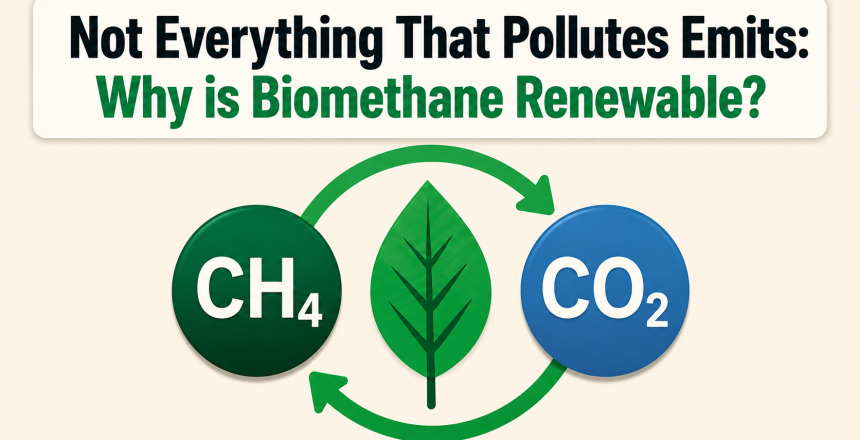
At first glance, it seems contradictory: how can a gas composed of methane (CH₄) and carbon dioxide (CO₂) — two of the main gases responsible for climate change — be considered a renewable energy source?
This is a common and understandable question, especially at a time when efforts to reduce greenhouse gas emissions are central to the global energy agenda. However, when we talk about biomethane —also known as Renewable Natural Gas (RNG) —we are referring to a gas that, while similar in composition to fossil natural gas, has a completely different origin, life cycle, and climate impact.
In a previous article, we explored how biomethane can replace conventional natural gas and facilitate the decarbonization of sectors that are difficult to electrify. If you haven’t read it, I invite you to do so by clicking here .
In this new installment, I will answer this fundamental question: why can a gas with emission potential, under certain conditions, be part of the climate solution and not part of the problem?
To answer this question, I will first review what biomethane is, how it is produced, how it differs from other renewable gases, and then I will explain why —from a scientific, environmental and regulatory point of view— not everything it emits pollutes .
What is Biomethane?
Biomethane, also known as Renewable Natural Gas (RNG) , belongs to the family of renewable gases and is composed primarily of methane. It is obtained through the refining of biogas, a crude gas generated by the anaerobic decomposition of organic matter: manure, agricultural waste, sewage sludge, or municipal solid waste.
Its 100% biological origin makes it a circular and low-emission energy source, aligned with the principles of sustainability and circular economy.

How does it differ from other renewable gases?
This gas is distinguished from other renewable gases primarily by its level of purity, its chemical composition, and its ability to be integrated into the existing natural gas infrastructure.
Unlike biogas , which is a raw mixture typically composed of 50% to 70% methane (CH₄) and 30% to 50% carbon dioxide (CO₂), along with traces of other compounds such as hydrogen sulfide, water vapor, and volatile organic compounds, natural gas refining (NGR) is a refined and purified version of biogas. Through advanced treatment processes—such as membrane separation, chemical absorption with amines, pressure swing adsorption (PSA), or cryogenic purification—undesirable compounds are almost completely removed, achieving a methane concentration exceeding 90% and even reaching levels of 96–98%, equivalent to fossil natural gas.
This purity gives it unique technical versatility among renewable gases, as it can be injected directly into natural gas distribution networks , stored in the same underground systems, or used as vehicle fuel (RNG-CNG or RNG-LNG) without requiring costly technical adaptations. In contrast, raw biogas cannot be used safely or efficiently in these applications without a prior upgrading process.
Compared to other renewable gases like green hydrogen , natural gas renewables (NGRs) also have distinct advantages. Hydrogen, while carbon-free, requires a completely different infrastructure for its transport, storage, and end use due to its physical properties (it is much lighter, highly flammable, and requires high pressures or cryogenic temperatures). In contrast, NGRs leverage existing infrastructure , significantly reducing implementation costs and timelines.
Similarly, syngas (synthesis gas), another renewable gas produced by gasification of biomass or solid waste, has a useful energy profile but its heterogeneous composition (mixture of carbon monoxide, hydrogen and methane) makes it less compatible with natural gas networks without additional reforming processes.

In summary, RNG differs from other renewable gases in three key aspects:
- Its high degree of purity makes it functionally equivalent to conventional natural gas.
- Its circular biological origin allows for the capture of methane emissions that would otherwise be released into the atmosphere, providing additional environmental benefits.
- Its compatibility with existing natural gas infrastructure facilitates its immediate deployment.
So why is this gas—composed of methane and CO₂—considered a renewable gas?
Biomethane is considered renewable mainly due to three key reasons:
1. Participation in a Closed Biogenic Carbon Cycle
The carbon present in both the methane and CO₂ in this gas comes from recent biomass : crop residues, manure, food, wastewater, etc. This carbon was recently captured from the atmosphere by plants (through photosynthesis) and by animals consuming biomass.
When these wastes decompose and produce biogas, they simply release the same carbon that was captured months or a few years earlier . This is why they are said to participate in a short or natural carbon cycle , which does not increase the net level of greenhouse gases in the atmosphere .
In contrast, when fossil fuels are burned , carbon is released from underground reserves that were not participating in the atmospheric cycle, and its massive entry into the atmosphere disrupts the climate balance .
Therefore, although it is chemically identical, this gas does not contribute to the net increase in greenhouse gases , as it is part of a natural carbon recycling cycle.
2. Capture of Unavoidable Emissions
This gas originates from sources that, if not properly managed, would release methane and CO₂ directly into the atmosphere, such as landfills, livestock waste, and wastewater. Therefore, capturing and utilizing this gas as an energy source makes it an effective emissions mitigation tool , transforming an environmental liability into a renewable energy resource. Capturing this gas and using it as energy:
- It prevents diffuse emissions that would otherwise be released uncontrollably.
- It allows transforming waste into a resource , aligning with the principles of the circular economy.
- It reduces climate impact, especially since uncaptured methane is 25 times more potent than CO₂ as a greenhouse gas over a 100-year horizon.
3. Technical and Regulatory Recognition
The world’s leading regulatory agencies, such as the European Union and the Environmental Protection Agency (EPA) in the U.S., consider that:
- If the gas is produced from sustainable biomass , its use can be classified as renewable energy .
- Gas is renewable even if it contains methane and CO₂ , as long as it is produced with appropriate technologies and under sustainability criteria.
This recognition makes it eligible for incentives such as clean energy certificates or carbon credits, which has boosted its adoption in sectors such as transport, industry and electricity generation, in many countries.
And what happens to the CO₂ from the biomethane separated during the upgrading process?
It’s important to distinguish here that this CO₂ isn’t just any byproduct: it’s biogenic , meaning it comes from fresh organic matter (like manure, agricultural waste, or sewage sludge). And that detail changes everything.
Because it comes from the decomposition of recent biomass, this CO₂ is part of the short carbon cycle , unlike CO₂ of fossil origin. This means that:
- Its emission does not alter the net balance of greenhouse gases , since it is carbon that the plants took from the air weeks or months ago, not millions of years ago.
- Its capture and reuse offers unique opportunities for the circular carbon industry, without increasing the atmospheric concentration of GHGs.
In short: although it is emitted, it does not pollute in net terms.
What options exist for managing that CO₂?
- Controlled release into the atmosphere is the simplest and cheapest option, but it fails to take advantage of the potential of the captured carbon. It does not generate additional benefits, although it also does not contribute to climate change if the source is biogenic.
- Capture and use in industrial applications (Bio-CCU) Here we enter an interesting area: biogenic CO₂ can be used in multiple applications such as: (1) Production of carbonated beverages; (2) Greenhouse crops (carbon fertilization); (3) Manufacturing of materials (such as e-fuels or polymers); (4) Water treatment and pH control.
- Carbon capture and storage (Bio-CCS): This option transforms the process into a negative emissions technology . By storing the captured CO₂ in geological formations or carbon-enriched agricultural soils, more emissions can be offset than are generated. This is one of the key aspects of the Carbon Dioxide Removal (CDR) concept .
Conclusion
The apparent paradox of biomethane—a gas composed of methane and CO₂ that is nevertheless considered renewable— dissolves when we understand its origin, its life cycle, and its net impact on the climate . Far from being a simple substitute for fossil natural gas, biomethane is a mature solution that connects the circular economy, smart waste management, and energy decarbonization.
Its production transforms environmental liabilities into energy assets, leverages existing infrastructure, and generates local social and economic benefits. In many ways, it is a bridging technology that allows us to advance the energy transition without waiting for more disruptive solutions to be ready for scaling.
Understanding why this gas can be part of the climate solution is key to accelerating its adoption and designing policies that strategically integrate it into our energy systems. Because when we talk about sustainability, it’s not just about avoiding emissions, but about reinventing how we produce, use, and value energy.
References
Is biomethane sustainable?
https://agriportance.com/es/conozca/biometano/es-sostenible-el-biometano