


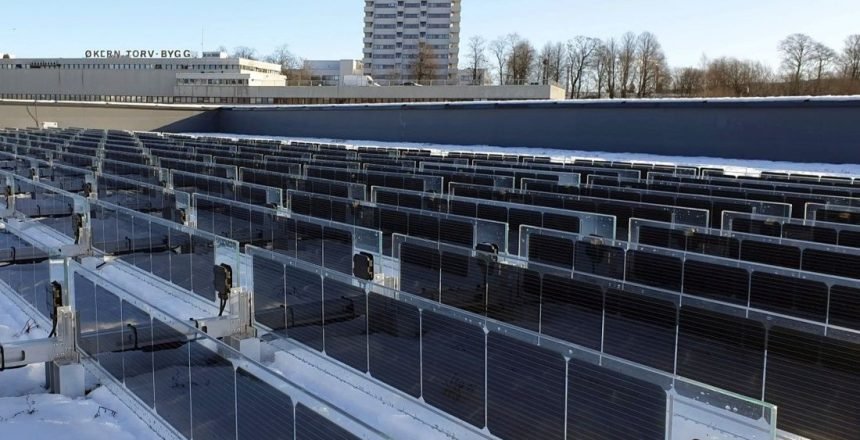
In this edition of Energy 4.0 , I want to answer a very interesting question I received from a newsletter reader, which may be of general interest: ” Vertical solar panels? Is that really possible and efficient?” The short answer is: yes! And below, we’ll explore why.
Tilt: a key factor in solar efficiency
Generally speaking, the tilt of solar panels is the standard critical factor for most installations, due to its impact on their efficiency and maintenance. This is because:
1. Maximizing solar energy capture
The movement of the Sun throughout the day and year, due to the Earth’s rotation and revolution, makes the tilt of the panels a key factor in optimizing electricity generation.
- When sunlight hits at an angle close to 90° (perpendicular), energy absorption is at its maximum.
- If the panel is at an unfavorable angle, the light is scattered and efficiency decreases.
- A completely horizontal (0°) or completely vertical (90°) panel would not optimally take advantage of sunlight in most locations.

2. Determination of the Optimal Inclination
In conventional photovoltaic systems, panels are typically installed at a fixed tilt to maximize sunlight capture throughout the year. The most common orientation is north in the Southern Hemisphere and south in the Northern Hemisphere. The optimal tilt for a solar panel depends on the latitude of the installation site.
- Seasonal adjustments : In winter , it is recommended to increase the tilt by 10-15° above the latitude. In summer , decrease it by 10-15° to better capture solar radiation.
- Systems with trackers : They dynamically adjust the tilt to follow the sun’s path and improve efficiency.
3. Additional Factors in Choosing the Slope
- Shadow and obstacles : A proper slope minimizes shading from nearby structures.
- Self-cleaning and maintenance : The sloping panels allow rainwater to remove dust, reducing the need for cleaning.
- Climatic conditions : In regions with snow, a greater slope prevents accumulations that could block light capture.
Vertical Installations: A Sound Alternative
While traditional tilt is key in most photovoltaic systems, vertical solar panel installations are gaining popularity in certain contexts, particularly with bifacial panels. Let’s see why:
1. Ideal for bifacial panels
- Bifacial panels capture sunlight on both sides and, by being oriented East-West (their most common and efficient configuration), in contrast to the orientation of conventional installations, they can maximize energy production throughout the day.
- In vertical installations, light reflected from the ground and other surfaces (albedo) increases energy production, especially in snowy terrain, covered with white gravel or surfaces with a high reflection index.
https://www.dsisolar.com/info/bifacial-pv-and-albedo-97372172.html
2. More balanced energy production
Unlike traditional systems, which reach their peak at midday, vertical bifacial panels generate more energy in the morning and afternoon.
This offers several advantages:
- Reduced temperature losses : Generating energy during cooler hours avoids thermal overload and improves efficiency.
- Better use of reflected and diffuse light : This is especially useful in areas with frequent cloud cover.
- More stable production curve : Benefits applications that require a constant supply or seek to maximize revenue by taking advantage of higher prices at the shoulders of the typical solar curve.

3. Greater durability and less maintenance
- The vertical arrangement allows snow and powder to slide off easily, reducing the need for cleaning and preventing the formation of hot spots.
- It also reduces the risk of breakage from hail, increasing the durability of the panels.
https://www.energias-renovables.com/fotovoltaica/aguantan-las-placas-solares-una-granizada-20220902
4. Space optimization
Vertical installations allow the use of areas that would otherwise be unused, such as:
- Acoustic barriers on highways
- Railway infrastructure
- Fences and building facades
This is key in urban environments where horizontal space is limited.

5. Applications in agrivoltaics
In projects that combine agriculture and solar energy , both in greenhouses and in open areas , vertical panels offer additional benefits:
- They optimize light distribution , favoring the growth of certain crops by providing more controlled shade adapted to the needs of the plants.
- They are easier to install and more cost-effective than elevated solar tracking systems, reducing initial and maintenance costs.
However, their generation density (kWp/m²) is lower than that of traditional systems, since they prioritize agricultural activity over photovoltaic production.
Conclusion
In summary, the installation of vertical solar panels, especially bifacial ones, is a real, efficient, and versatile alternative in specific contexts. Their ability to capture sunlight from both sides, combined with the use of albedo, optimizes energy production, particularly on reflective surfaces such as snow-covered terrain. Furthermore, their vertical configuration offers more balanced energy generation throughout the day, minimizing heat loss and maximizing efficiency.
Beyond their energy benefits, vertical panels stand out for their ability to optimize space use, integrating innovatively into urban infrastructure such as noise barriers and building facades. Their application in agrivoltaics also offers significant potential, facilitating the harmonious coexistence of agriculture and solar energy generation. While it is true that generation density may be lower compared to traditional systems, the advantages in terms of durability, reduced maintenance, and space efficiency position them as a valuable and constantly evolving option within the solar energy landscape.
It is important to note that, although the optimal tilt of solar panels in equatorial latitudes tends to favor more horizontal configurations, bifacial vertical systems can still offer substantial benefits in specific applications. The key lies in conducting a thorough assessment of local conditions, including albedo, diffuse solar radiation, and the specific needs of each project, to determine the most efficient and cost-effective configuration.
In the references, I’ve included some resources of interest on the topic. Until next time!
References
Bifacial Vertical Solar Panels – Better than normal ones?
Bifacial Solar Panels – The BEST Solar Panel? Real World Results!
Have we been doing Solar wrong all along?
Vertical Bifacial Solar Panel Performance Results Part 1
Bifacial Solar Panels are CHANGING the Game! Vertical Results Part 2.
Improving vertical bifacial PV system performance with free-space luminescent solar concentrators